
AI search is fundamentally changing how users find and interact with brands online. Platforms like Google AI Overviews, ChatGPT, Perplexity, and Gemini are generating direct answers rather than directing users to websites, so traditional SEO metrics no longer capture the full picture of organic performance.
For organizations that depend on organic search to drive pipeline and revenue, this shift creates a measurement gap. Visibility is emerging, demand is being shaped, and brand impressions are forming, but none of it shows up in a standard analytics dashboard.
The ability to monitor SEO performance in AI search is no longer optional. It is a core requirement for understanding whether your strategy is working, where to allocate resources, and how to demonstrate ROI from AI-driven search investments.
Why Traditional SEO Metrics Fall Short in AI Search
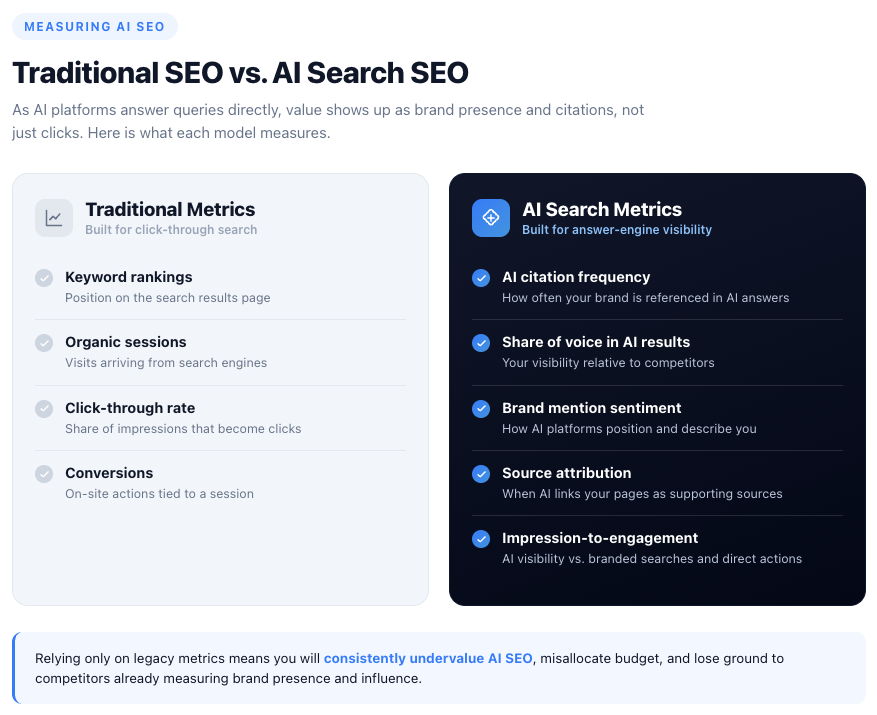
Traditional SEO has always centered around a predictable set of performance indicators: keyword rankings, organic sessions, click-through rates, and conversions. These metrics were built for a search environment where users clicked through to websites to find answers.
AI search disrupts this model. When a large language model generates a response that includes your brand, cites your content, or references your expertise, that visibility creates real business value. But it may never register as a click in Google Analytics or Search Console.
This does not mean the impact is not there. It means the measurement framework must evolve. Organizations that continue relying exclusively on legacy metrics will consistently undervalue their AI SEO efforts, misallocate budget, and lose ground to competitors who are already adapting their measurement approach to capture this new layer of search-driven revenue influence.
The New Metrics That Matter for AI SEO
To accurately track AI SEO performance, organizations need to expand their measurement framework beyond clicks and sessions. The metrics that matter in AI search reflect a shift from traffic acquisition to brand presence and influence.
The most important areas to measure include:
- AI citation frequency, which tracks how often your brand or content is referenced in AI-generated responses
- Share of voice in AI results, measuring your visibility relative to competitors within AI-generated answers
- Brand mention sentiment, which evaluates how your brand is positioned and described by AI platforms
- Source attribution, tracking when AI platforms link or reference your specific pages as supporting sources
- Impression-to-engagement ratio, comparing AI-driven brand visibility against downstream actions like direct searches and branded queries
These metrics provide a far more accurate picture of how AI search is driving awareness, consideration, and demand than traditional analytics alone.
How to Monitor SEO Performance in AI Search
Monitoring SEO performance in AI search requires a combination of new tools, adjusted workflows, and a broader definition of what counts as a meaningful interaction.
The process starts with establishing visibility baselines. Before optimizing, organizations need to understand where they currently appear in AI-generated results and how frequently their content is being cited or referenced.
From there, AI SEO tracking becomes an ongoing discipline built around several key activities:
- Regularly querying AI platforms with your target keywords and documenting whether your brand appears in responses
- Using AI visibility monitoring tools to automate citation tracking across platforms like ChatGPT, Perplexity, Google AI Overviews, and Gemini
- Cross-referencing AI visibility data with branded search volume trends in Google Search Console, since increases in branded queries often signal growing AI-driven awareness
- Monitoring referral traffic from AI platforms, which is beginning to appear as identifiable traffic sources in analytics
- Tracking indexed content performance to ensure the pages AI platforms are citing remain optimized and authoritative
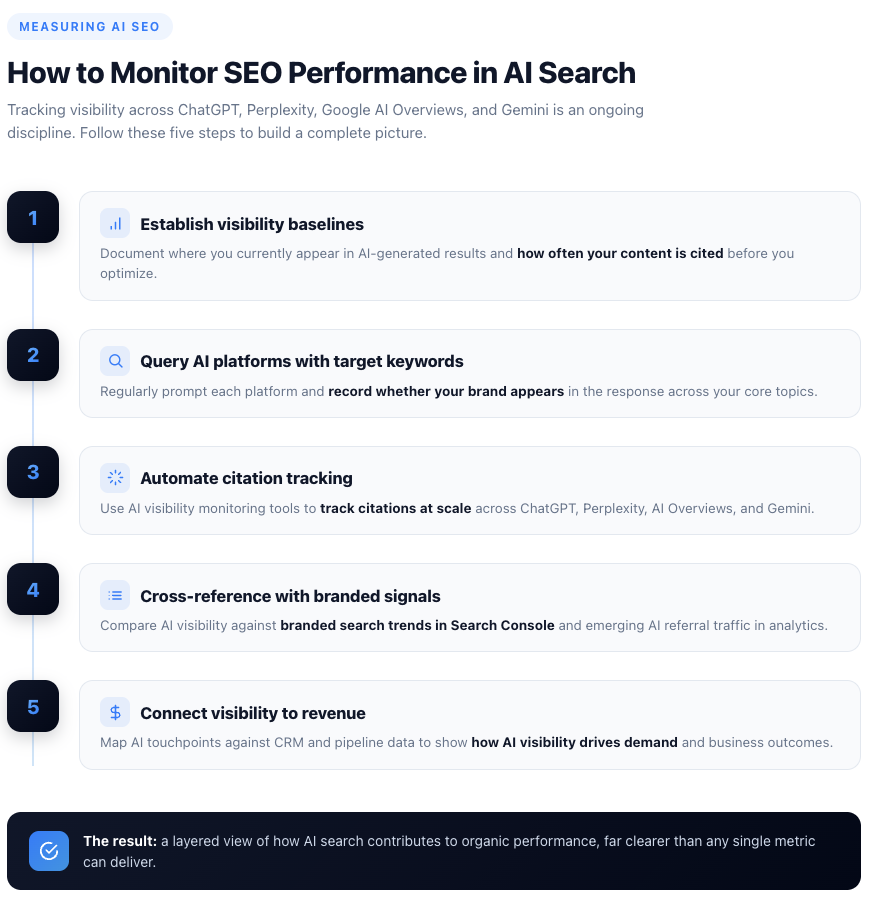
This layered approach provides a much clearer view of how AI search contributes to overall organic performance than any single metric could.
Connecting AI SEO Performance to Business Outcomes
Measuring visibility is important, but it only becomes meaningful when connected to business outcomes. This is where most AI SEO measurement strategies fall short. They track presence without connecting it to the pipeline or revenue.
To bridge this gap, organizations should focus on correlating AI visibility with downstream business signals:
- Increases in branded search volume following AI citation growth, which indicates demand generation
- Direct traffic trends that align with periods of high AI visibility
- Conversion rate changes on pages frequently cited by AI platforms
- Pipeline and revenue data from CRM systems that can be mapped against organic and AI-driven touchpoints
This approach mirrors the attribution logic used in multi-touch enterprise SEO measurement, but extends it to include AI-generated touchpoints within the customer journey. When done correctly, it demonstrates how AI search performance translates into measurable business growth.
Tools and Platforms for AI SEO Performance Tracking
The tooling landscape for AI SEO tracking is evolving rapidly. While no single platform captures every dimension of AI search visibility, several categories of tools are emerging to fill the gap.
The most effective AI SEO measurement stacks typically include:
- AI visibility platforms that monitor brand mentions and citations across major AI models and search experiences
- Traditional SEO platforms like Ahrefs, SEMrush, or Search Console for baseline keyword and traffic tracking
- Brand monitoring tools that capture mentions across AI-generated content and emerging search surfaces
- Analytics platforms configured to segment and identify AI-referred traffic
- CRM and attribution systems that connect organic and AI touchpoints to revenue
Organizations that invest in building this measurement infrastructure early will have a significant advantage in understanding and optimizing their AI search performance as the space matures. More importantly, they will be able to draw a clear line between AI visibility investments and revenue impact, which is essential for securing continued budget and executive support.
The key is not to wait for a single all-in-one solution. The organizations seeing the most value are now assembling purpose-built stacks, iterating on their approach, and building institutional knowledge that compounds over time. This mirrors the early days of traditional SEO analytics, where the teams that invested in measurement first captured outsized returns.
How to Measure the Effectiveness of an AI SEO Strategy
Understanding how to measure the effectiveness of an AI SEO strategy requires stepping back from individual metrics and evaluating performance at the strategic level.
This means asking the right questions at regular intervals:
- Is your brand appearing in more AI-generated responses over time across your core topics and keywords?
- Are AI citations driving measurable increases in branded search volume, direct traffic, or engagement?
- Is the content being cited by AI platforms aligned with your highest-value products, services, or conversion paths?
- Are you gaining or losing share of voice in AI results relative to your competitors?
- Is there a demonstrable correlation between AI visibility improvements and business outcomes like leads, pipeline, or revenue?
When these questions can be answered with data, the AI SEO strategy moves from experimental to accountable. This is the shift that separates organizations testing AI SEO from those that are scaling it as a growth channel.
Accountability is what unlocks investment. When leadership can see that AI SEO is generating measurable demand, influencing the pipeline, and contributing to revenue, it becomes far easier to justify expanding resources and a long-term commitment to the channel.
Building a Reporting Framework for AI SEO
Reporting on AI SEO performance requires a framework that combines traditional organic metrics with AI-specific visibility data into a single, coherent narrative.
The most effective reporting structures include three layers:
The first layer covers traditional organic performance, including keyword rankings, organic traffic, and conversion data. This establishes the baseline and ensures continuity with existing SEO reporting.
The second layer introduces AI visibility metrics, including citation frequency, share of voice, source attribution, and platform-level presence. This is where the new value of AI SEO becomes visible.
The third layer connects both to business outcomes, showing how combined organic and AI-driven visibility contributes to branded demand, pipeline, and revenue.
This three-layer approach ensures that AI SEO reporting is both comprehensive and executive-ready. It avoids the common pitfall of presenting AI metrics in isolation, which often leads to skepticism from stakeholders who need to see revenue impact.
The Future of Measuring SEO in AI Search
AI search is not a temporary trend. It is a structural shift in how information is discovered, evaluated, and acted upon. As AI platforms continue to mature and gain market share, the ability to measure performance within these environments will become a defining capability for competitive organizations.
The organizations that invest now in understanding how to measure SEO in Google AI Mode and across other AI platforms will be positioned to optimize more quickly, allocate budgets more effectively, and demonstrate clear business impact from their AI SEO investments.
Measurement is what turns AI SEO from a speculative initiative into a scalable, accountable growth channel. It is the mechanism that connects AI visibility to pipeline, revenue, and long-term business growth.
The organizations that build this capability now will not only optimize faster. They will be the ones who can prove the value of their investment, secure ongoing resources, and turn AI search into a durable competitive advantage.
Frequently Asked Questions: Measuring AI SEO Performance
What is AI SEO performance measurement? AI SEO performance measurement is the process of tracking how your brand and content appear in AI-generated search results across platforms like Google AI Overviews, ChatGPT, Perplexity, and Gemini. It goes beyond traditional metrics like clicks and rankings to include citation frequency, share of voice, and source attribution within AI responses.
Why can’t I just use Google Analytics to measure AI SEO? Google Analytics captures website traffic and conversions, but it does not track visibility within AI-generated answers. When an AI platform references your brand without sending a click, that value is invisible in traditional analytics. Measuring AI SEO requires supplemental tools and methods to capture this broader impact.
How do I monitor SEO performance in AI search? Start by querying AI platforms with your target keywords to document current visibility. Then implement AI visibility monitoring tools to automate citation tracking. Cross-reference AI visibility data with branded search trends and referral traffic to build a complete picture of performance.
What metrics should I track for AI SEO? The most important metrics include AI citation frequency, share of voice in AI results, brand-mention sentiment, source attribution, and the correlation between AI visibility and increases in branded search volume or direct traffic.
How long does it take to see results from AI SEO? AI SEO results typically begin appearing within 3 to 6 months as content is indexed and cited by AI platforms. Measurable business impact, such as increases in branded search volume and downstream conversions, generally becomes visible within 6 to 12 months.
What tools can I use to track AI SEO performance? Effective AI SEO tracking stacks include AI visibility platforms for citation monitoring, traditional SEO tools like Ahrefs and Search Console for baseline data, brand monitoring tools, analytics platforms configured to segment AI traffic, and CRM systems for connecting AI touchpoints to revenue.
How does AI SEO performance connect to business outcomes? AI visibility drives business outcomes by increasing branded search volume, direct traffic, and engagement on cited pages. When mapped against CRM and pipeline data, these signals demonstrate how AI search contributes to demand generation, lead quality, and revenue growth.