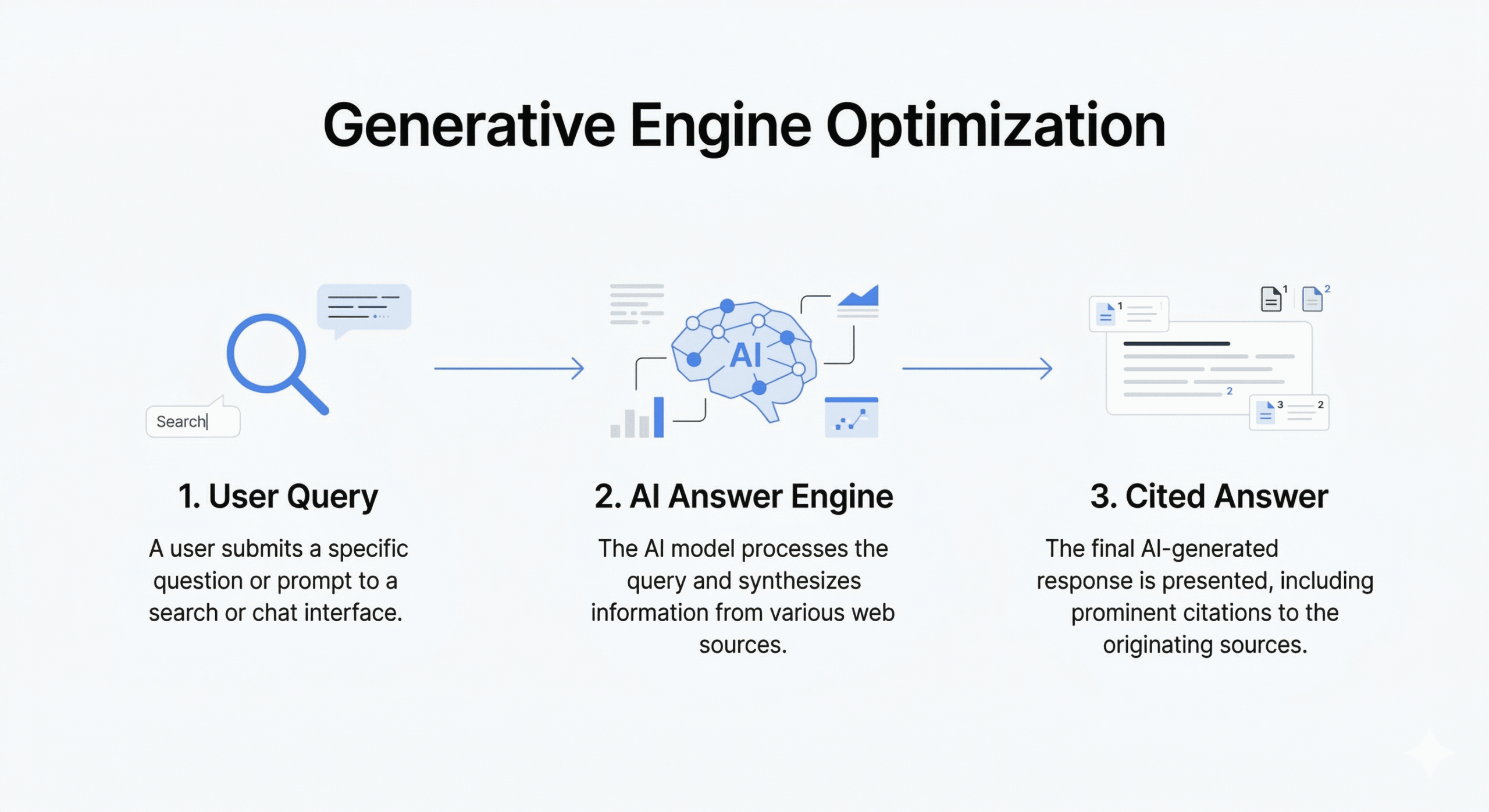
Generative Engine Optimization Services: Your Guide to AI-Powered SEO
Search has fundamentally changed. AI-powered platforms like ChatGPT, Perplexity, Google AI Overviews, and Gemini no longer hand users a list of links and step aside. They generate the answer directly, drawing from sources they’ve already decided to trust. For businesses, that shift carries a single high-stakes implication: if your content isn’t being cited, it isn’t being seen. At SEO Brand, generative engine optimization services exist to solve exactly that problem.
What Is Generative Engine Optimization?
Generative engine optimization (GEO) is the practice of optimizing digital content so AI-powered search engines cite and reference it when generating answers. AI SEO services help AI systems recognize your content as a trusted source on a specific topic.
Traditional SEO vs GEO
Traditional SEO means optimizing for placement, or getting a webpage ranked in a list of results. GEO optimizes for selection, as in, getting your content chosen as the source an AI draws from when constructing its answer. As Princeton GEO research has established, that distinction matters because generative engines don’t operate on keyword-matching logic. They develop a contextual understanding of documents and queries that makes traditional ranking tactics insufficient on their own. That research was the first to formally define GEO as a new paradigm where content creators aim to maximize their visibility within AI-generated responses.
When someone asks ChatGPT about your industry, GEO influences whether the AI references your expertise or a competitor’s. That shift from rankings to citations demands a fundamentally different approach to digital visibility.
AI search platforms analyze context, evaluate source credibility, and synthesize information across multiple inputs before generating a response. Your content needs to be structured to support that process at every stage.
The underlying driver is a durable shift in user expectations. Consumers have moved away from scanning a page of links toward expecting immediate, authoritative answers. AI search is the infrastructure that delivers them.
Think of it this way:
- Traditional SEO = optimizing for a librarian using an index
- GEO = optimizing for an assistant that reads, understands, and answers
What GEO Services Focus On
- Content clarity and structure: This means making information easy for AI systems to parse.
- Authoritative positioning: We position your content as a trusted source worth citing.
- Technical optimization: We use structured data, entity markup, and semantic signals to help AI understand context and relationships.
How AI Search Engines Generate Answers
Understanding how AI generates responses helps explain why traditional SEO tactics often fall short.
- Large language models (LLMs): They process vast amounts of text to understand patterns, relationships, and meaning.
- Retrieval-augmented generation (RAG): This combines trained knowledge with real-time sources, so content quality matters.
- Source citations: Platforms show where answers come from, which makes visibility easier to measure.
- Entity recognition: AI identifies people, places, and concepts to understand authority beyond keywords.
Beyond those core mechanisms, AI systems are also evaluating content quality in ways traditional algorithms never could. They assess clarity, completeness, and factual consistency rather than just topical relevance. The training process itself draws on billions of data points from web pages, academic sources, and high-authority publications, meaning the credibility signals AI systems respond to are far more sophisticated than anything a keyword-density metric could capture. That’s also what makes content quality so consequential. Citation analysis research has found that between 50% and 90% of AI-generated citations don’t fully support the claims they’re attached to. Shallow or poorly structured content isn’t just less likely to be cited; it’s more likely to be misrepresented when it is.
Generative Engine Optimization vs Traditional SEO
The differences between traditional SEO and GEO go deeper than tactics. As the AIOSEO guide puts it, SEO focuses on ranking in keyword-driven search engines, while GEO is tailored to AI-driven engines that prioritize context, user intent, and advanced algorithms for enhanced relevance and engagement.
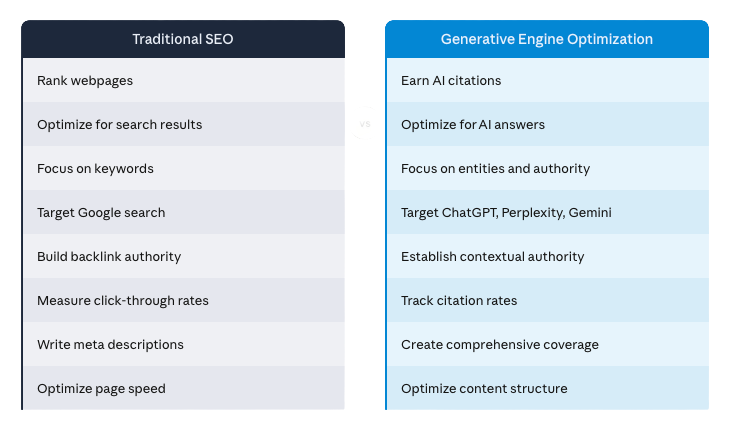
The strategic question changes entirely. Traditional SEO asks how to rank higher. GEO asks how to become the source that AI systems select when generating an answer. And those are not the same optimization problem.
Keyword stuffing, thin content, and link volume become liabilities in this environment. AI systems can recognize shallow coverage and will favor sources that demonstrate genuine depth and topical authority. The signals that matter shift toward entity clarity, factual specificity, and comprehensive topic coverage that anticipates follow-up questions rather than just targeting a primary query.
Where traditional SEO rewards keyword density and backlink profiles, GEO rewards content that an AI could confidently extract, cite, and stand behind. The underlying goal is visibility and becoming the reference point your category trusts.
Why Generative Engine Optimization Matters for Businesses
The numbers make the case for change. According to McKinsey research, around half of all Google searches already surface AI-generated summaries (a figure expected to climb past 75% by 2028. Half of consumers now intentionally seek out AI-powered search engines, with a majority naming it the top digital source they use to make buying decisions. And that includes a majority of baby boomers, not just younger generations. That same research projects $750 billion in U.S. revenue will flow through AI-powered search by 2028, and brands unprepared for the shift could see traditional search traffic decline anywhere from 20 to 50 percent.
Industry statistics show that Google AI Overviews already reach 2 billion monthly users, roughly 60% of searches now yield no clicks, and nearly 35% of Gen Z in the U.S. use AI chatbots as their primary search tool. A Search Engine Land analysis cites Gartner’s prediction that traditional search volume will drop 25% this year as users migrate to AI-powered answer engines. And with ChatGPT now serving 800 million users per week, the scale of that migration is no longer theoretical.
Click-based metrics are losing structural relevance, not just relative importance. When more than 60% of searches resolve without a click, and AI summaries are on track to cover 75% of Google results by 2028, the traditional click-through rate becomes an incomplete measure of digital performance. Businesses that continue optimizing solely for clicks are measuring the wrong outcome.
Being cited by an AI platform is a categorically different kind of visibility than a search ranking. A ranking puts your link in front of someone who may or may not click. A citation embeds your brand into the answer itself, thus reaching users at the moment a decision is being formed, often before they’ve visited any website at all.
Early adopters of generative engine optimization services can build advantages that compound over time. That said, the research makes clear that AI citation behavior is not a simple reward system. Platforms change, citation overlap between ChatGPT and Perplexity sits at just 11%, and sources that appear regularly today can drop off sharply. That’s precisely why consistent, multi-platform authority matters more than chasing any single platform’s algorithm.
For enterprise businesses, for example, traditional enterprise SEO alone is no longer enough to protect digital visibility. Users want immediate, useful answers, and AI is increasingly meeting that need.
Consistent AI citations also drive brand recognition in a way that operates independently of traffic. When your content is repeatedly named as a source across ChatGPT, Perplexity, and Google AI Overviews, users begin to associate your brand with expertise before they ever visit your site, sometimes without visiting at all. That kind of pre-purchase authority is difficult to manufacture through advertising and impossible to buy through paid search.
The revenue implications are real, but the mechanism works differently from traditional search. GEO builds the brand authority and citation presence that influences decisions upstream. One important expectation to calibrate: AI crawlers consume content at a dramatically higher rate than they refer traffic back. Research tracking crawler behavior found that for every visitor an AI platform refers back to a website, its crawlers have already visited tens of thousands of pages. Direct referral traffic is a secondary output of GEO. The primary return is authoritative positioning at the point where buying decisions are made.
How Generative Engine Optimization Works
The GEO process starts with an AI visibility audit. This helps us understand current citation rates across different platforms. From there, we can spot gaps and opportunities.
Core components of GEO include:
- Entity optimization, so AI systems correctly identify our brand, products, and areas of expertise
- AI citation optimization, so our content has a stronger chance of being referenced
- Content structure optimization, so information is easy to extract through clear headings and logical flow
- Authority and trust signals, so our expertise appears consistent across our digital presence
- Ongoing monitoring, so we can track citation performance across AI platforms
Technical implementation includes structured data markup, schema optimization, and semantic HTML. These elements help AI systems interpret content relationships and context, though it’s worth noting that research has found schema markup alone doesn’t directly drive citation selection. It supports content interpretation, but it’s not a substitute for information quality and structural clarity.
AI Citation Report findings reveal why multi-platform authority is especially important. Brand search volume — not backlinks — is the number one predictor of LLM citations (0.334 correlation coefficient), and sites with a presence on four or more platforms are 2.8 times more likely to appear in ChatGPT responses. The research also found that adding statistics increases AI visibility by 22% and including quotations boosts it by 37%.
Examples of AI Search Platforms GEO Targets
- ChatGPT draws from its training data and web browsing capabilities to answer questions and tends to favor clear, well-structured content.
- Google AI Overviews synthesizes information from multiple sources and prioritizes direct, factual answers with strong E-E-A-T signals.
- Perplexity shows inline source citations on nearly every response and rewards detailed, specific content. It’s worth noting that its citation accuracy rate sits below 50% according to peer-reviewed analysis, meaning the citations it shows don’t always fully support the claims attached to them. Detailed, verifiable content gives you the best shot at being cited accurately, not just cited.
- Claude emphasizes accuracy and nuance, which makes deep expertise and balanced perspectives important.
- Gemini integrates with Google’s ecosystem and values strong, useful content.
- Bing Chat prioritizes recent, accurate, and actionable information.
Each platform has its own preferences for structure and authority signals, and they behave differently when it comes to growth and referral traffic. BrightEdge AI search study data shows Claude achieved 58% growth in referral traffic in July alone, ChatGPT significantly outpaces all other emerging AI engines in referral volume, and Grok registered 1,279% growth from a small base. That means your optimization strategy has to be tailored to each platform’s unique signals and momentum.
Benefits of Generative Engine Optimization
The most immediate benefit of GEO is AI visibility that doesn’t depend on a click, and includes:
- Authority citations that strengthen brand credibility
- Greater brand recognition through consistent mentions
- Higher conversion intent from users already exposed to our expertise
- A search strategy built for the future
- Better cost efficiency than ongoing paid advertising
Do Businesses Need Generative Engine Optimization Services?
AI search optimization can overwhelm internal marketing teams without specialized experience. Generative engine optimization services involve:
- Technical SEO
- Entity optimization
- AI citation monitoring
- Multi-platform analysis
Because of that, many companies work with specialized GEO agencies. At our digital marketing agency, we bring experience that helps businesses handle this work with clarity and consistency.
AI citation tracking requires specialized tools and ongoing analysis. Understanding which content earns citations and why goes beyond traditional SEO metrics.
A generative engine optimization agency provides strategy along with technical execution. Working with a generative engine optimization company can speed up results and reduce costly mistakes. Experience across industries gives us insights that are hard to replicate in-house.
That investment supports stronger visibility, greater authority, and long-term competitive advantage. GEO services cover the full range of work needed for AI visibility, which lets businesses stay focused on daily operations while experts handle the execution.
The Future of GEO and AI Search
AI is becoming the default interface for information, not a supplement to traditional search. Voice queries, conversational commerce, and real-time AI-generated answers are no longer emerging behaviors; they are the direction the entire ecosystem is moving in.
Key developments include:
- Conversational commerce, where AI recommends products and services
- More personalization based on user behavior and context
- Expansion into voice, smart devices, and wearables
- Multimodal AI that combines text, voice, image, and video understanding
The convergence of search, AI, and commerce is creating a new competitive surface, one where authority is established before the click, and where the brands that show up in AI answers will increasingly be the brands that win the conversion. Professional generative engine optimization services are the mechanism for securing that position. The question is no longer whether GEO belongs in your strategy. It’s how much ground you’re willing to cede while waiting to start.
Frequently Asked Questions
What is generative engine optimization?
Generative Engine Optimization (GEO) is the practice of optimizing content for AI-powered search engines and chatbots. Unlike traditional SEO and content marketing, which focus on keyword research, implementation, and rankings (among many other technical and non-technical tactics), GEO helps your content stay structured, authoritative, and easy for AI systems to understand, trust, and cite when answering user questions.
How is GEO different from SEO?
SEO aims to rank webpages in search results, while GEO focuses on earning citations inside AI-generated responses. Instead of optimizing for clicks, GEO focuses on visibility within answers.
Which AI platforms use GEO strategies?
GEO applies to platforms like ChatGPT, Google AI Overviews, Perplexity, Claude, Gemini, and Bing Chat. Any system that generates answers from external sources depends on similar principles.
How long does GEO take to work?
It can take a few weeks to a few months, depending on existing authority, content quality, and competition. Consistency and depth usually help speed up results.
Can GEO help my brand appear in ChatGPT answers?
Yes, GEO can increase the chance that your content is recognized and referenced by AI systems like ChatGPT. It does not guarantee placement, but it can improve visibility and authority within responses.