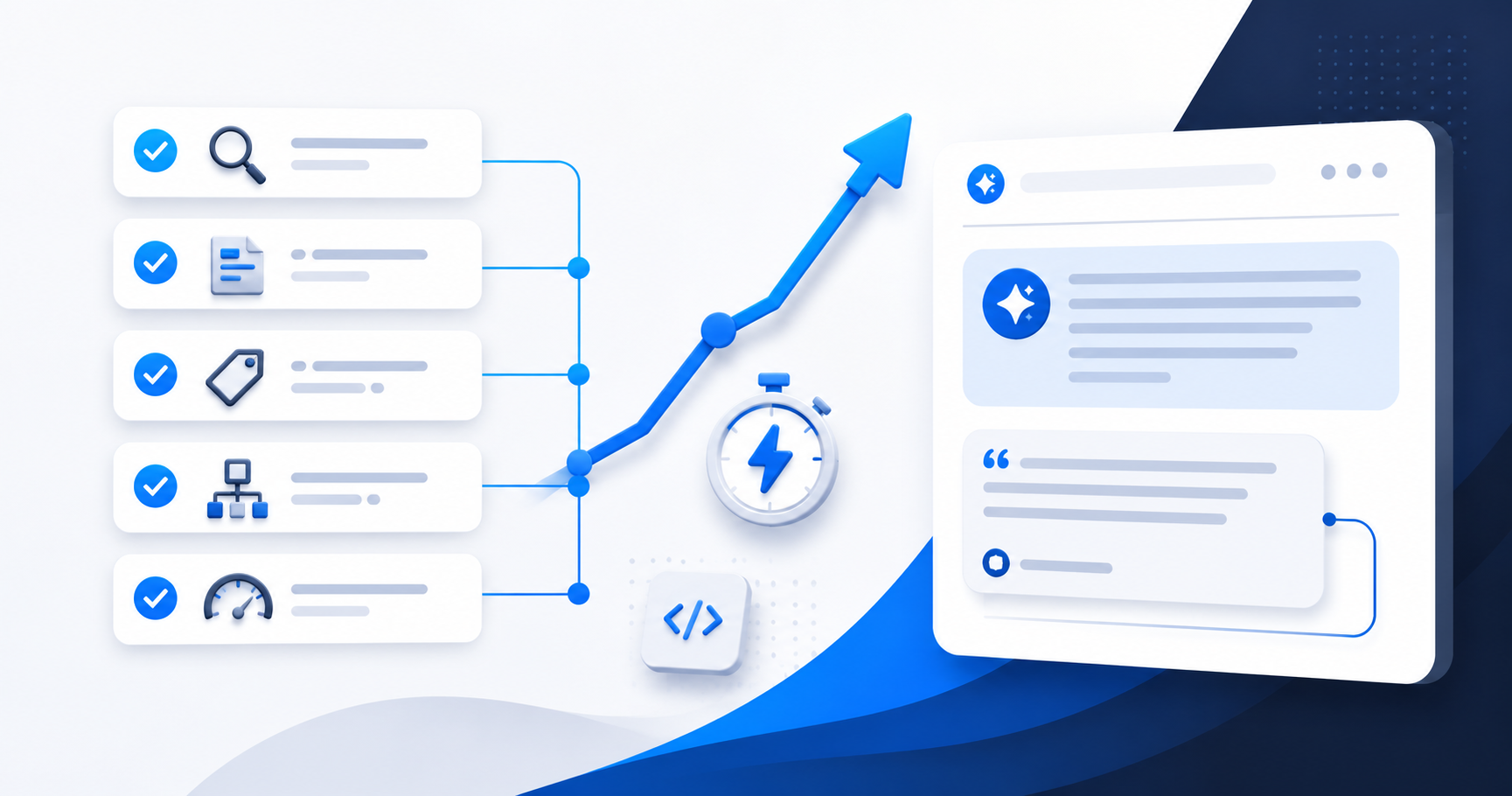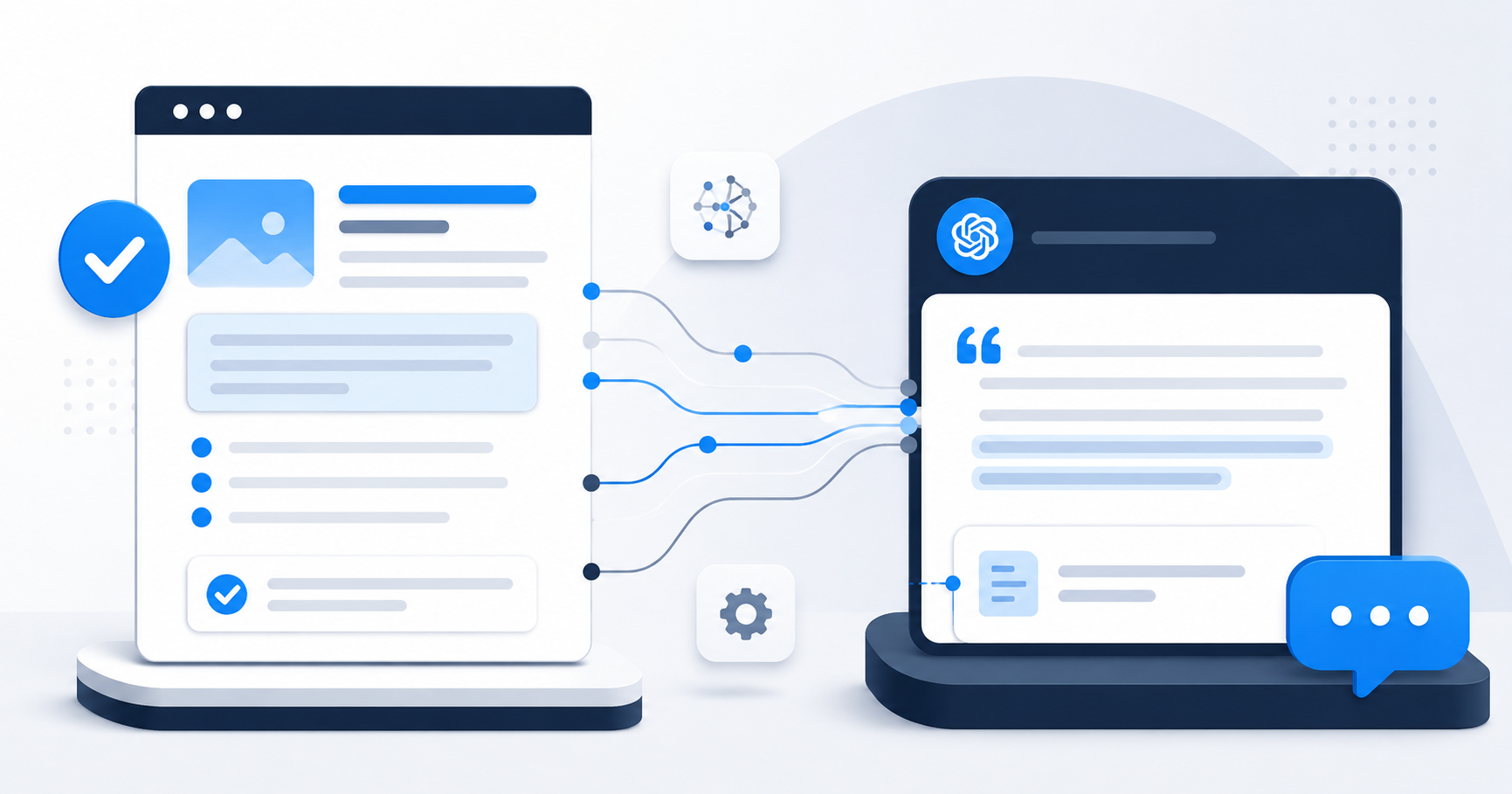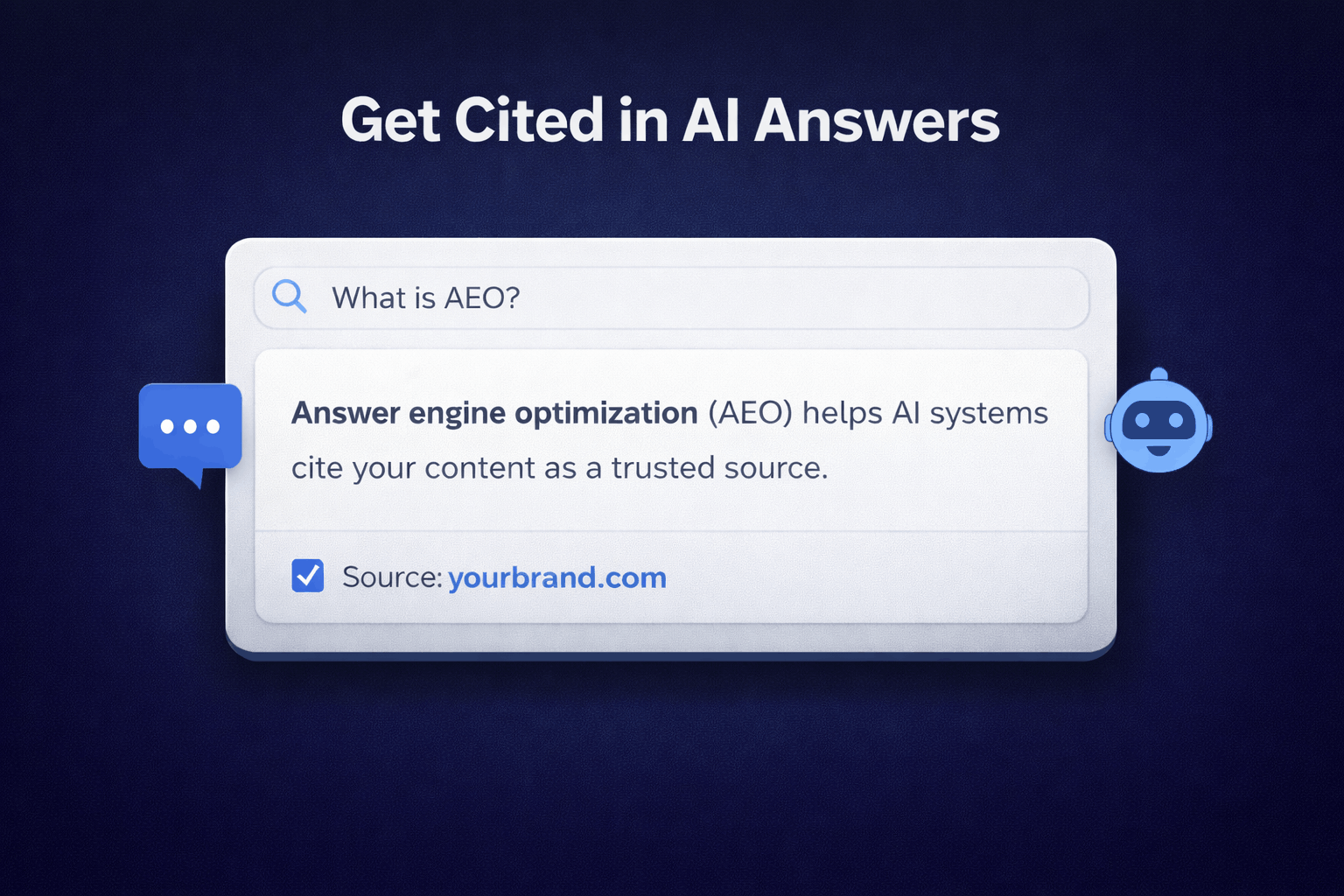
Organic clickthrough rates have plummeted in the age of AI. But the clicks you do get have more purchasing intent behind them. That’s why you need to be visible in AI search. Here’s what you need to know. It starts with answer engine optimization.
Here’s our answer engine optimization definition: It’s the practice of structuring content so AI systems like ChatGPT, Google AI Overviews, and Perplexity can extract, trust, summarize, and cite your brand as the authoritative source in search queries.
Answer engine optimization, and AEO in SEO (more on that later), aren’t just the next big things in the forecast. They’re what separate visible brands from invisible ones, right now.
Search Has Changed. It’s Time to Catch Up
Recently, most searches have ended without a single click. Don’t expect that trend to die down. Users get their answer from an AI-generated response and move on.
If your content isn’t built to be cited by those systems, you’re losing brand exposure, right when someone needs what you offer.
In this guide, we cover some of the big questions today’s businesses need to be asking:
- What is answer engine optimization?
- Why does it matter?
- How does AEO work alongside SEO?
- What can you do now to optimize your web content?
Understanding Answer Engine Optimization: The New SEO Reality
Traditional search engines return links. Answer engines return conclusions. ChatGPT, Perplexity, Google AI Overviews, and Gemini don’t just index pages. They read them, synthesize from multiple sources, and deliver a direct response in plain language.
That changes what ranking means. In traditional SEO, ranking means appearing on page one and earning a click. In AEO, ranking means being the source an AI system trusts enough to pull from when building its answer.
Here’s what answer engines look for that traditional search doesn’t:
- Comprehension over keywords. AI systems evaluate whether content clearly explains a concept, not just whether it contains the right phrases.
- Extractability. Content needs to be structured so specific answers can be pulled out cleanly, without losing accuracy or context.
- Source credibility. AI systems are selective. They favor sources with demonstrated authority, consistent information, and external validation.
Answer engine optimization isn’t replacing SEO. It’s the next layer on top.
The Numbers Don’t Lie: Why AEO in 2026 Is Non-Negotiable
The data makes the case fast. Here’s why you need to care:
- AI Overview now accounts for a 58% drop in clickthrough rates.
- ChatGPT processes more than two billion queries daily.
- 66% of the global population uses AI tools regularly.
Those aren’t projections. That’s the current state of search, and it has direct consequences for how businesses get found.
The visibility shift runs deeper than the stats suggest:
- Being cited beats being ranked. Brand visibility now depends on being named as an authoritative source in an AI-generated answer, not just appearing in a list.
- AI citations carry real trust. When Perplexity or ChatGPT cites your content, users treat it as a credible recommendation. That’s different from a search result that they have to evaluate themselves.
- Purchase intent is higher. Users who click through from AI-generated answers tend to demonstrate higher purchase intent. That’s because AI experiences filter out low-intent users and concentrate on decision-ready audiences.
What Is AEO in Digital Marketing? How It Fits Your Existing Strategy
What is AEO in digital marketing? It’s the deliberate layering of answer engine optimization on top of your existing SEO foundation, not a replacement for it.
Traditional SEO focuses on ranking signals: keywords, backlinks, page speed, and technical health. Those fundamentals don’t go away. Answer engines still rely on crawlable, well-structured content. Without strong SEO, AI systems may never find your pages in the first place.
AEO in SEO adds a focused layer on top:
- SEO gets your content discovered by search engines and AI crawlers.
- AEO ensures that content can be understood, trusted, and cited once it’s found.
The practical adjustments are less dramatic than they sound. Headers get more question-focused. Opening sentences lead with direct answers. Content goes deep enough to anticipate follow-up questions. Schema markup signals content structure explicitly.
One nuance worth knowing: different AI systems weigh content differently. Google AI Overviews leans hard on E-E-A-T signals. ChatGPT values thorough, balanced explanations. Perplexity favors well-cited, source-backed content.
A solid baseline strategy serves all three, with targeted refinements based on where your audience spends time.
AEO vs. SEO vs. GEO: What Each One Does and How They Work Together
Three optimization frameworks now shape AI search visibility. They’re interconnected, not competing.
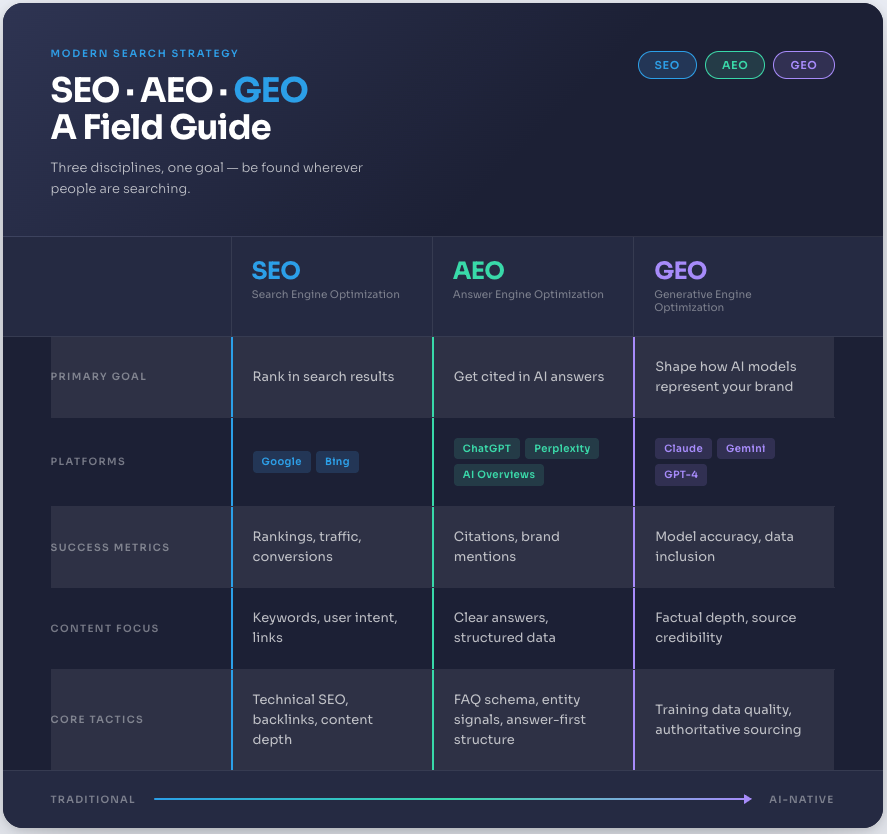
In practice, these approaches reinforce each other. Content that serves user intent thoroughly (SEO), uses clear schema markup (AEO), and cites authoritative sources (GEO) performs across all three at once.
Businesses winning in 2026 don’t choose between these frameworks. They layer them. A single article can target traditional SEO keywords, include structured FAQ sections for AEO, and provide deep, well-cited coverage for GEO.
How to Format Content So AI Systems Actually Use It
AI systems don’t just read your content. They extract from it. Formatting isn’t only about readability. It’s about making specific information easy to pull out accurately.
-
Lead Every Section With the Answer
AI systems frequently pull opening sentences as standalone statements. Put the key point first, then follow with context and detail. If the answer is buried in paragraph three, the model will instead find a page that leads with it.
-
Make Your Headings Do Real Work
H2s and H3s should be specific and descriptive, ideally mirroring the questions your audience actually searches. When an AI needs to answer ‘How does X work?’, it looks for content that already has that structure in place. Vague headings are missed extraction opportunities.
-
Use Lists and Tables Strategically
Bulleted lists get extracted cleanly for multi-part answers. Numbered lists work for processes. Comparison tables are go-to sources for AI systems handling ‘difference between X and Y’ queries. Use these formats whenever content has more than two related points.
-
Keep Paragraphs Short
Two to three sentences per paragraph is the target. Long, dense blocks create context confusion when AI systems extract individual sentences. Short paragraphs also read better on mobile.
-
Add FAQ Sections With Direct Answers
Q&A pairs are among the most cited content formats in AI responses. Each answer should stand alone in two to four sentences. Apply FAQPage schema to flag the format explicitly. AI systems treat it as a direct instruction: here’s a question, here’s the answer.
-
Apply Schema Markup
Schema tells AI systems what your content means, not just what it says. The types that matter most for AEO:
- FAQPage: flags Q&A pairs as structured and extractable.
- HowTo: identifies step-by-step processes.
- Article: provides context about the content’s purpose, author, and publication date.
- Organization: clearly identifies your business entity.
You don’t need to write the schema by hand. Rank Math and Yoast generate it automatically for WordPress. Validate what’s live with Google’s Rich Results Test.
Build the Kind of Authority AI Systems Can’t Ignore
Content structure gets AI systems to consider you. Authority signals build trust in you. Both are required.
E-E-A-T: Still the Standard, Now More Important
Experience shows through specific examples and client results. Expertise comes from thorough, technically accurate coverage of topics. Authoritativeness builds through consistent quality and external citations. Trustworthiness comes from transparency, proper sourcing, and factual accuracy. AI systems evaluate all four when deciding whether to cite a source.
Author Credentials Matter More Now
AI systems increasingly factor in the author of the content when assessing trustworthiness. Clear author bios, links to professional profiles, and visible credentials give AI systems confidence signals. This matters especially for YMYL topics such as health, finance, and legal content.
Cite Sources. Be a Source Worth Citing.
Citing authoritative sources signals to AI systems that you’re building on established knowledge. It also increases the likelihood that those sources will reference you in return. Quality external links and earned inbound mentions are both authority signals that AI systems recognize.
Build Topical Authority Through Content Clusters
One article on a topic is a data point. A cluster of interconnected, thorough content signals deep expertise. When AI systems see multiple strong pieces from your domain covering a subject from multiple angles, they treat you as a go-to authority worth citing consistently.
Your Off-Site Footprint Counts
Brand mentions in industry publications, expert roundups, and authoritative directories reinforce your entity signals for AI systems. When trusted third-party sources reference your brand in relevant contexts, AI systems register those connections as credibility signals. It goes beyond traditional link building.
Real AEO Challenges and How to Get Past Them
Content Depth Takes Real Investment
AEO content can’t skim the surface. It needs enough depth to answer follow-up questions, not just the primary query. That means genuine subject matter expertise, whether from experienced writers, internal SMEs, or both. There’s no shortcut here that holds up over time.
Schema Implementation Feels Intimidating
It doesn’t have to be. Start with the FAQ and Article schema using Google’s Structured Data Markup Helper. Most CMS platforms include schema tools that handle the basics without touching code. Add more sophisticated markup as you build traction.
Measuring AEO Results Isn’t Straightforward
You can’t track AI citations the way you track rankings. Build new habits instead:
- Test your brand and key service queries in ChatGPT and Perplexity monthly.
- Monitor Bing referral traffic. ChatGPT browses through Bing, so a rise there is a real signal.
- Track featured snippet captures in Google Search Console.
- Set up Google Alerts for your brand name and core service terms.
- Use Semrush or Ahrefs; both are rolling out dedicated AI visibility features.
The measurement ecosystem is catching up fast. Build visibility now. Tracking will meet you there.
Balancing AEO and Traditional SEO
This isn’t a choice between two things. AEO elements, clear structure, schema markup, and answer-first writing should be standard practice from the start, not retrofitted later. Built in from day one, the increase in workload is minimal, and the compounding benefit across both traditional and AI search is significant.
Every AI Platform Is a Little Different
Don’t try to fine-tune for every platform at once. Prioritize based on where your audience actually is. B2B companies tend to see the most impact from ChatGPT and Perplexity. Local businesses get strong returns from Google AI Overviews and voice search. Start there, then expand.
Where AEO Is Headed: What to Prepare for Now
Multi-Modal AI Is Coming
Future answer engines will process images, video, and audio alongside text. Content with descriptive alt text, video transcripts, and properly labeled media will be positioned for citation across modalities. Start building those habits now.
Personalization Will Intensify
AI systems are already tailoring responses based on user context and history. Audience-specific content becomes more valuable as personalization scales. Content that clearly addresses different segments without losing signals of authority will hold up better over time.
Freshness Will Matter More
As AI systems pull real-time data more effectively, regularly updated content will outperform static pages on time-sensitive topics. Build update cycles into your content calendar, especially for stat-heavy guides and comparison articles.
Early Authority Compounds
Domains that establish credibility with AI systems now are building trust that’s hard for competitors to close later. The brands investing in answer engine optimization today are creating a structural advantage in AI search. That gap widens the longer you wait.
Answer Engine Optimization FAQs
Q: How long does it take to see results from answer engine optimization?
Most businesses see initial traction within three to six months, with more meaningful gains between six and twelve months. Timeline depends on domain authority, content quality, and competitive density. Early wins like schema markup and answer-first restructuring can shift AI citation patterns within weeks.
Q: What is the difference between answer engine optimization and SEO?
SEO focuses on ranking in search results to earn clicks and traffic. Answer engine optimization focuses on being cited in AI-generated answers, even when users may never click through. Both require quality content and domain authority, but AEO adds specific requirements around content structure, entity signals, and schema markup that traditional SEO doesn’t prioritize.
Q: Which AI platforms should I optimize for first?
Prioritize based on where your audience is. B2B companies typically see the most impact from ChatGPT and Perplexity. Local businesses and service providers get strong returns from Google AI Overviews and voice assistants. Start where your buyers already spend time, then expand as you build traction.
Q: How do I measure AEO success?
Standard analytics won’t surface AI citation data directly. Test key queries in ChatGPT and Perplexity monthly. Monitor Bing referral traffic, since ChatGPT’s browsing feature pulls content through Bing. Track featured snippet captures and set up Google Alerts for brand mentions. Semrush and Ahrefs are both building out dedicated AI visibility reporting.
Q: Can I do answer engine optimization without technical expertise?
Yes, for most of the foundational work. Content restructuring, answer-first writing, and FAQ formatting require no technical skills. Schema markup is manageable through plugins like Rank Math and Yoast on WordPress. For advanced work like custom schema types or site architecture audits, that’s when bringing in a specialist pays off.
Q: Is answer engine optimization worth the investment?
The case is strong. Users who encounter brands through AI-generated answers show higher purchase intent than those arriving via traditional search. Brand search volume increases significantly after sustained AI visibility. And many B2B buyers now use AI during their research phase. Not optimizing for AI search means being absent during decisions that drive revenue.
Q: How does Google AI Overviews affect my AEO strategy?
Google AI Overviews draws from indexed pages and heavily evaluates E-E-A-T signals. Keep content current, use structured data, and make sure each page leads with a direct answer to its primary question. Strong organic SEO performance helps here, since AI Overviews tends to favor pages that already rank well.
Q: What content types perform best in answer engines?
How-to guides with numbered steps, FAQ pages, comparison articles, and authoritative topic explainers consistently perform well. Content that leads with a direct answer and uses clear H2 and H3 headings is most likely to be cited. Thin pages, keyword-stuffed content, and articles without a clear answer structure get passed over.
Your Audience Is Already Using AI to Make Decisions. Are You Showing Up?
AI search isn’t a trend to monitor. It’s already how buying decisions get made. The brands building AEO into their strategy now are earning trust and visibility that compounds over time.
You don’t need to overhaul everything at once. Start with content structure, add schema markup, and make sure your brand entity is clear and consistent across the web.
It’s always a good idea to call in the pros. Get your free proposal from SEO Brand, and we’ll show you exactly where your biggest AI visibility opportunities are.