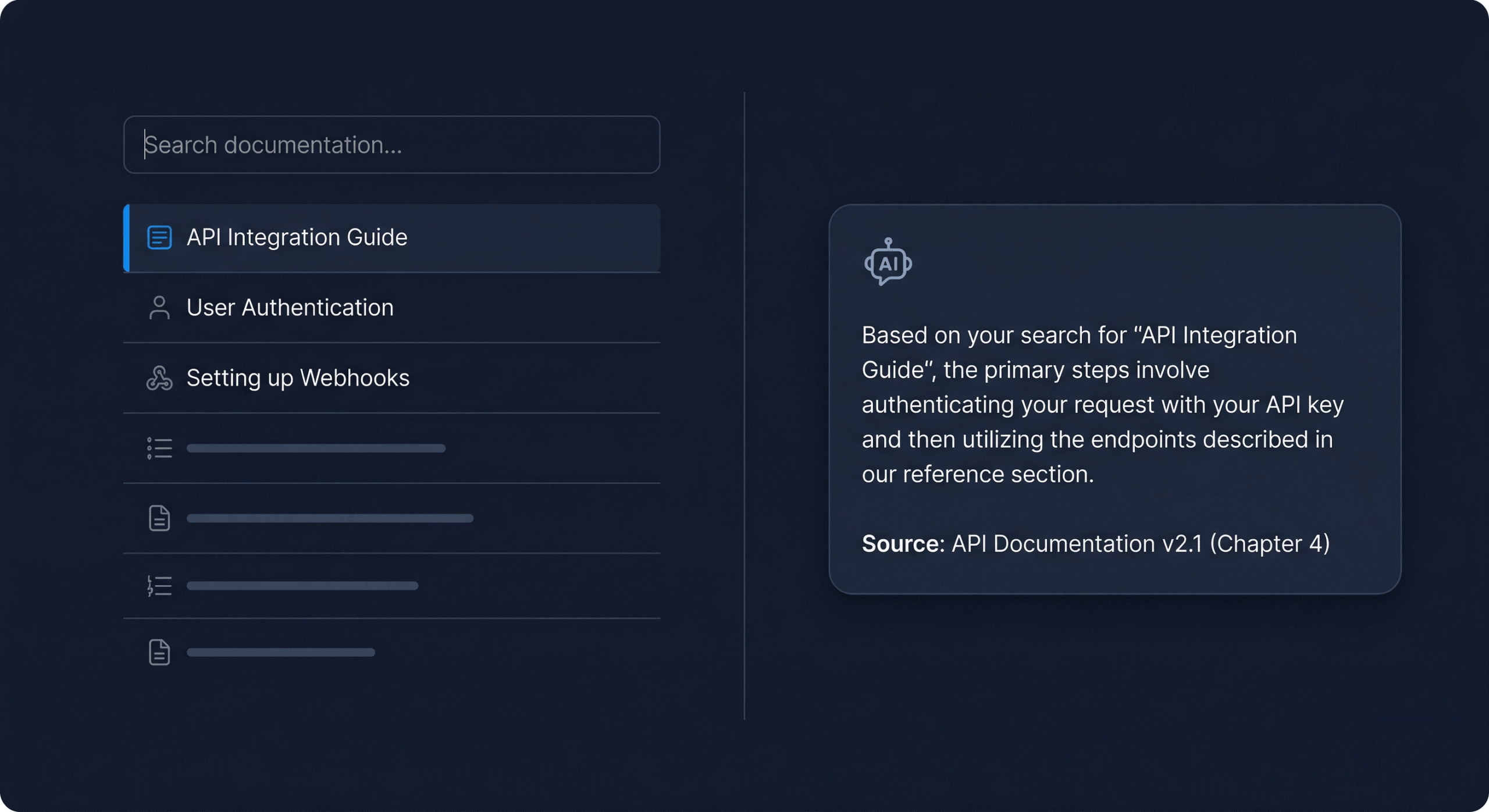
Most marketing teams are running a single SEO strategy even as search behavior has shifted. Traditional search still matters, but AI-powered platforms like ChatGPT, Perplexity, and Google AI Overviews handle an increasing share of queries, often in hybrid formats that blend answers with links. That answer either includes your brand or it doesn’t.
AI SEO optimizes content for AI-driven engines that generate answers, while traditional SEO ranks webpages in search results pages. These aren’t competing strategies. They’re parallel visibility problems that most businesses solve halfway.
What Is Traditional SEO?
Traditional SEO improves a website’s visibility in search engine results pages (SERPs) on platforms like Google and Bing. The goal is to rank highly for relevant keywords so users click through to your site. Traffic from traditional SEO is click-based. A user searches, sees your result, and visits your page. Performance is measured in rankings, impressions, and click-through rate.
The core pillars of traditional include:
- Keywords: matching the terms your audience searches for
- Backlinks: earning links from authoritative sites to signal credibility
- Technical SEO: optimizing for site speed, crawlability, and proper structure
- On-page optimization: titles, headings, meta descriptions, and content quality
What Is AI SEO?
AI SEO optimizes content to get selected, cited, or summarized by AI platforms, generating direct answers. It draws from three emerging industry terms:
- Generative Engine Optimization (GEO): optimizing for AI platforms that synthesize answers from multiple sources, such as Google AI Overviews and Perplexity
- Answer Engine Optimization (AEO): structuring content to directly address specific user questions across both traditional and AI search
- LLM Optimization: shaping how large language models like ChatGPT and Claude understand, reference, and represent your brand or expertise
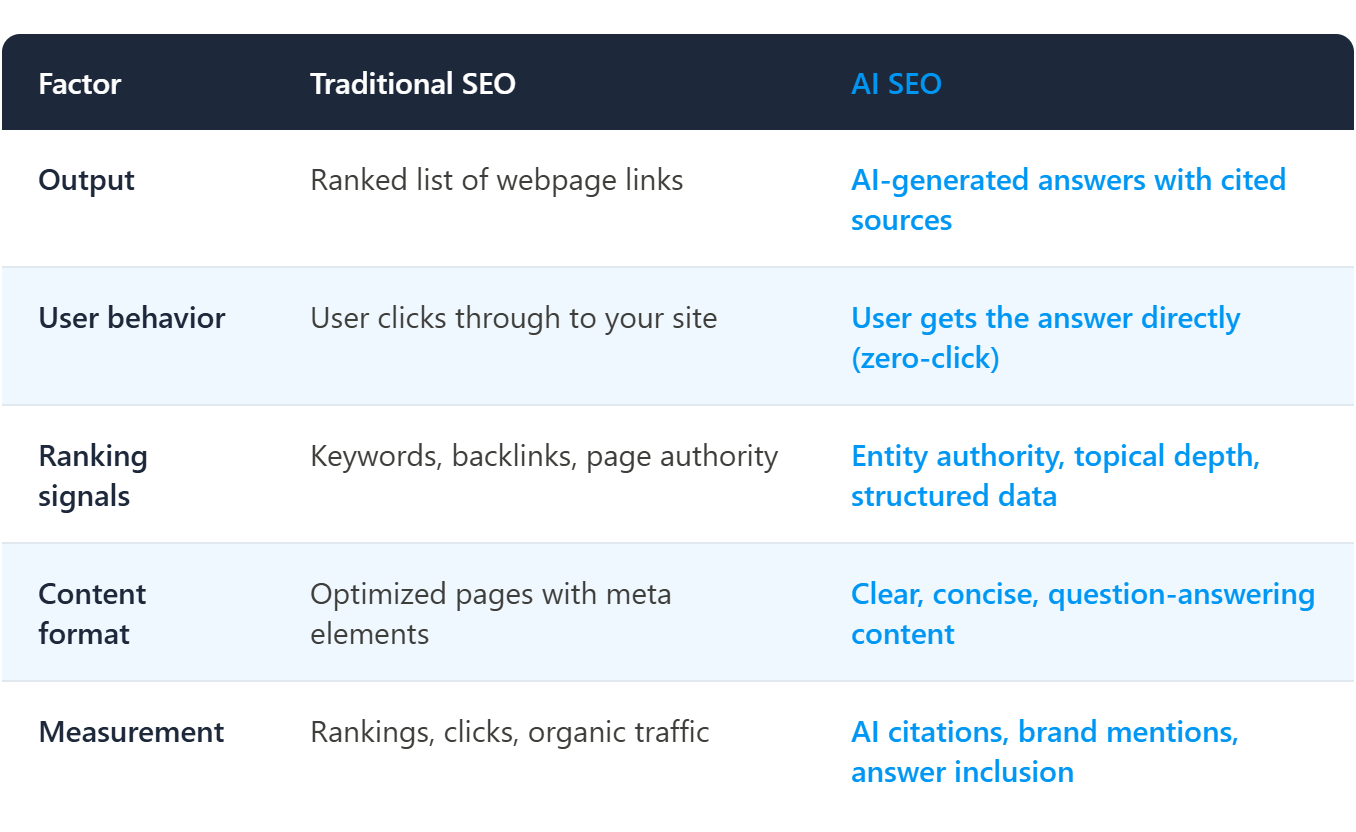
Unlike traditional SEO’s list-ranking approach, AI SEO focuses on source selection for AI-constructed answers.
Traditional SEO vs. AI SEO
How AI Search Is Changing SEO
The practical impact on organic performance is already visible in traffic data. Google AI Overviews now reach 2 billion monthly users. Roughly 60% of searches resolve without a click. Nearly 35% of Gen Z in the U.S. use AI chatbots as their primary search tool, and McKinsey research projects that AI-generated summaries will cover more than 75% of Google results by 2028.
That’s a direct problem for businesses relying on click-through metrics to measure search performance. When most searches don’t generate a click, ranking well doesn’t guarantee visibility.
Three factors are redefining what strong SEO performance looks like:
- Structured data helps AI systems parse and surface your content accurately
- Entity authority, or how clearly and consistently your brand is defined across the web, influences whether AI models treat you as a credible source worth citing
- Topical depth now matters just as much as (if not more than) keyword density; AI platforms favor content that demonstrates genuine subject matter expertise across a full topic cluster, not just a primary query
When Your Business Needs AI SEO
The case for AI SEO is strongest when the gap between your search presence and your AI presence is already costing you.
- Your organic traffic is declining while impressions hold steady — your content still appears in search, but AI summaries are absorbing the clicks before users reach you
- Your competitors are showing up in AI-generated answers, and you’re not — when ChatGPT, Perplexity, or Google AI Overviews cite other brands in your category, you’re ceding authority at the moment decisions are forming
- Your industry is information-dense or highly competitive — finance, healthcare, legal, SaaS, and professional services are especially vulnerable to AI answer displacement
- Organic search drives a significant share of your pipeline — the higher your dependence on organic traffic, the higher the stakes of not adapting
AI SEO vs SEO: Which Is Right for Your Business?
The framing of “AI SEO vs. SEO” implies a choice. In practice, it isn’t one.
Traditional SEO builds the foundation: authority, technical health, content quality, and the credibility signals that AI systems use to evaluate sources. Generative engine optimization extends that foundation into the platforms where search is heading. Skipping traditional SEO leaves your site without the foundation AI citations depend on. Skipping AI SEO means your well-ranked content still doesn’t show up where a growing share of your audience is looking.
The right approach is a hybrid strategy, one that maintains strong SERP rankings while positioning your content to be cited, summarized, and referenced by AI platforms. That’s not a future consideration. For businesses in competitive categories, it’s already the present one.
How to Get Started With AI SEO
Adding AI SEO services to your existing strategy doesn’t mean rebuilding from scratch. It means layering in the optimization work that your current approach isn’t covering.
- Audit your current visibility: Review organic traffic trends, current rankings, and whether your brand appears in AI-generated answers for your core topics. Understanding the gap is the starting point.
- Identify AI search opportunities: Find the questions your audience asks that AI tools are already answering, and assess where your content has a realistic shot at inclusion.
- Optimize content for AI retrieval: Restructure key pages to answer questions directly, concisely, and with clear topical authority. AI platforms favor content that’s easy to extract and cite and penalize shallow coverage by passing over it entirely.
- Implement schema and entity optimization: Add structured data markup (FAQ, How-To, Article schema) and ensure your brand’s entity relationships are clearly and consistently defined across your site and third-party sources. Research shows that sites with a presence on four or more platforms are 2.8 times more likely to appear in ChatGPT responses.
- Track AI visibility alongside traditional metrics: Monitor brand citations across AI tools, watch zero-click trends, and adjust your content strategy based on where you’re showing up and where you’re losing ground.
Not sure where your current strategy stands? Request an AI visibility audit or speak with digital marketing experts to find out what you’re missing.
Frequently Asked Questions
What is AI SEO?
AI SEO is the practice of optimizing content for AI-driven search engines that generate direct answers, such as ChatGPT, Google SGE, and Perplexity, rather than just ranking webpages in traditional search results.
Is AI SEO replacing traditional SEO?
No, rather, AI SEO builds on traditional SEO. It does not replace it. Technical SEO, content quality, and authority still matter; they now also influence visibility in AI-generated answers.
What is the difference between AI SEO and traditional SEO?
Traditional SEO focuses on ranking webpages in search engine results pages. AI SEO focuses on getting content selected and cited in AI-generated answers.
How do you optimize for AI search?
Optimizing for AI search involves creating structured, authoritative content, using clear entity relationships, implementing schema markup, and answering questions directly and concisely.
What are GEO and AEO?
Generative Engine Optimization (GEO) focuses on optimizing content for AI-generated responses. Answer Engine Optimization (AEO) focuses on structuring content to directly answer user questions in both search and AI systems.