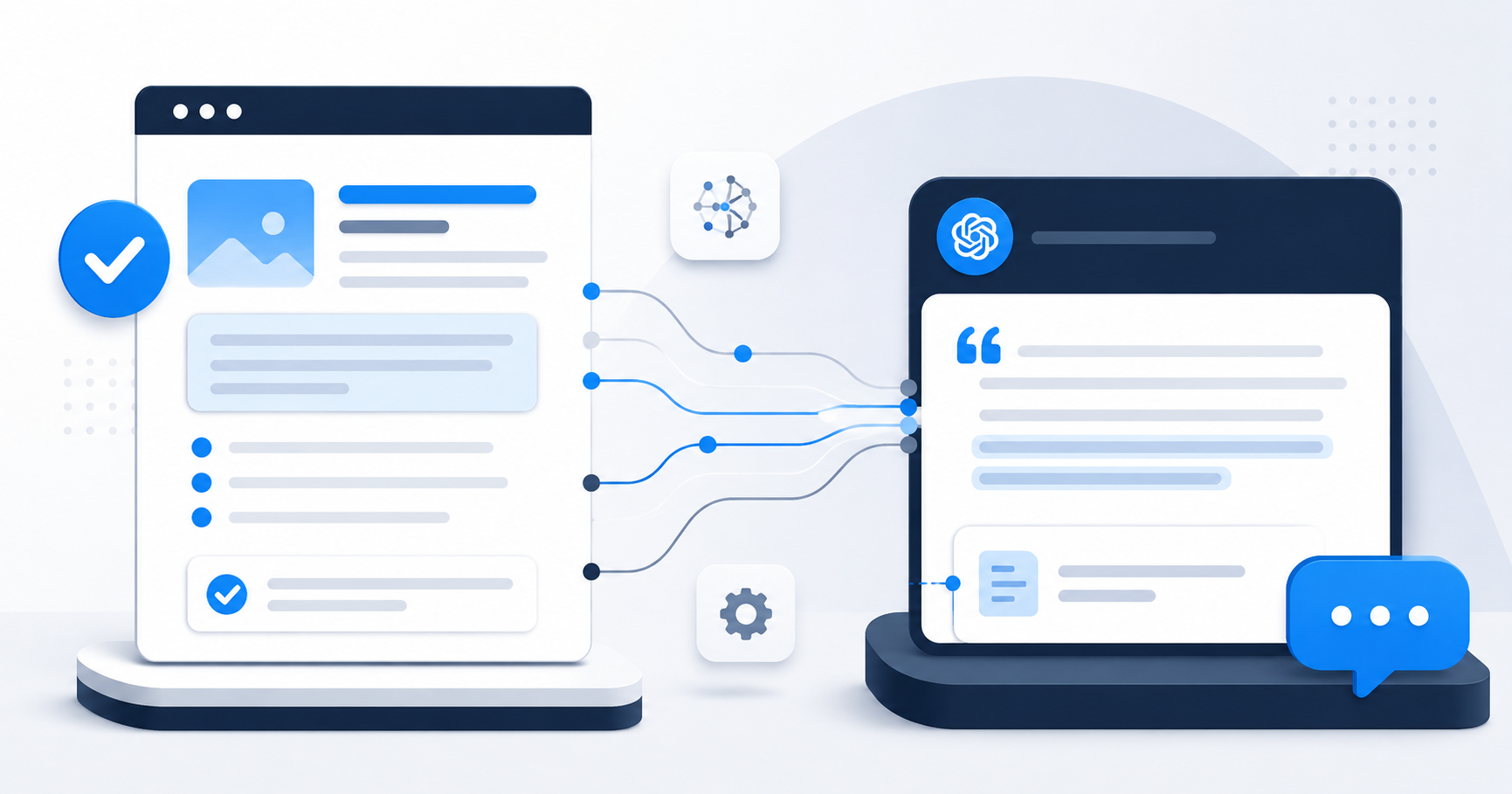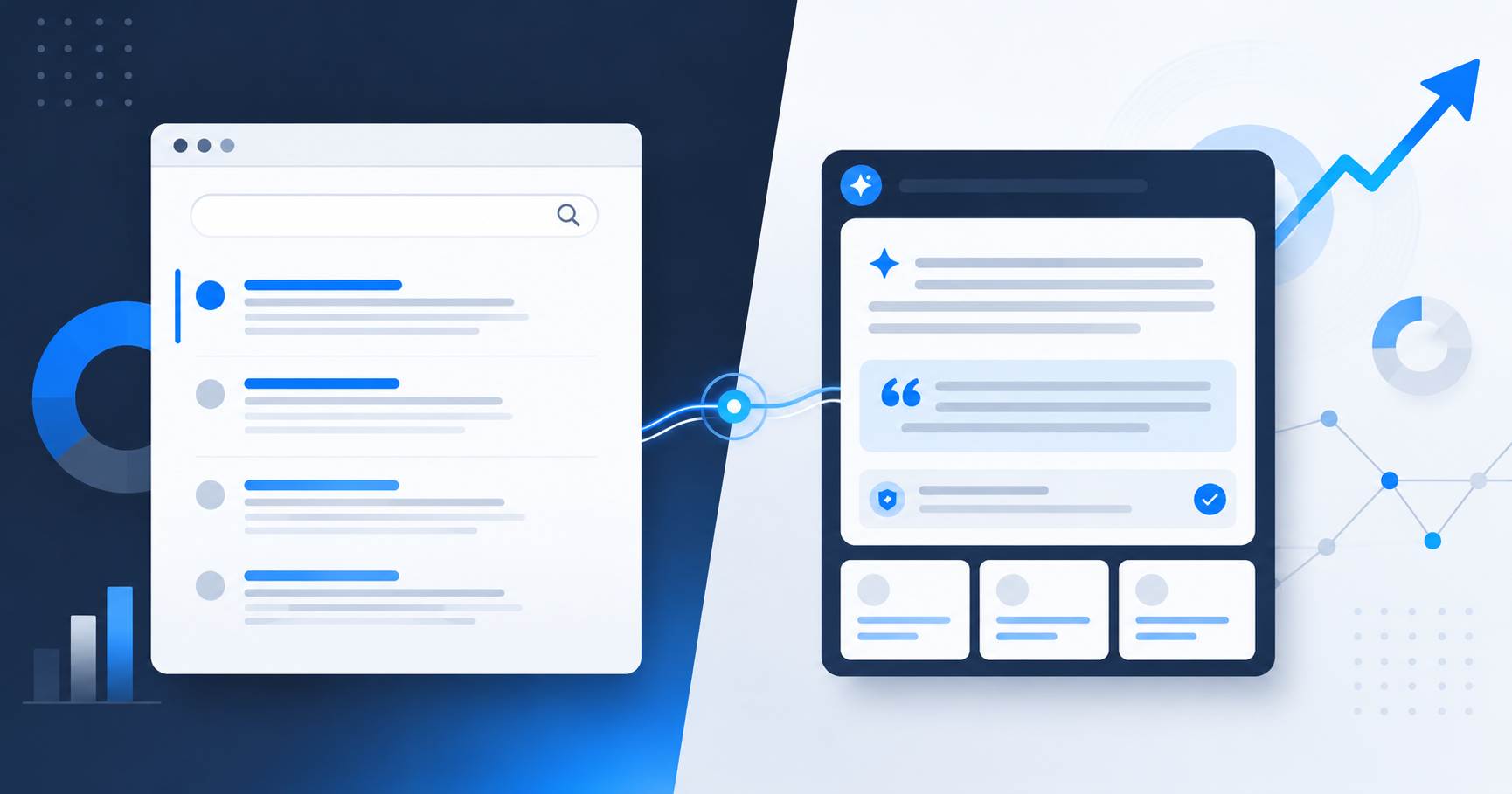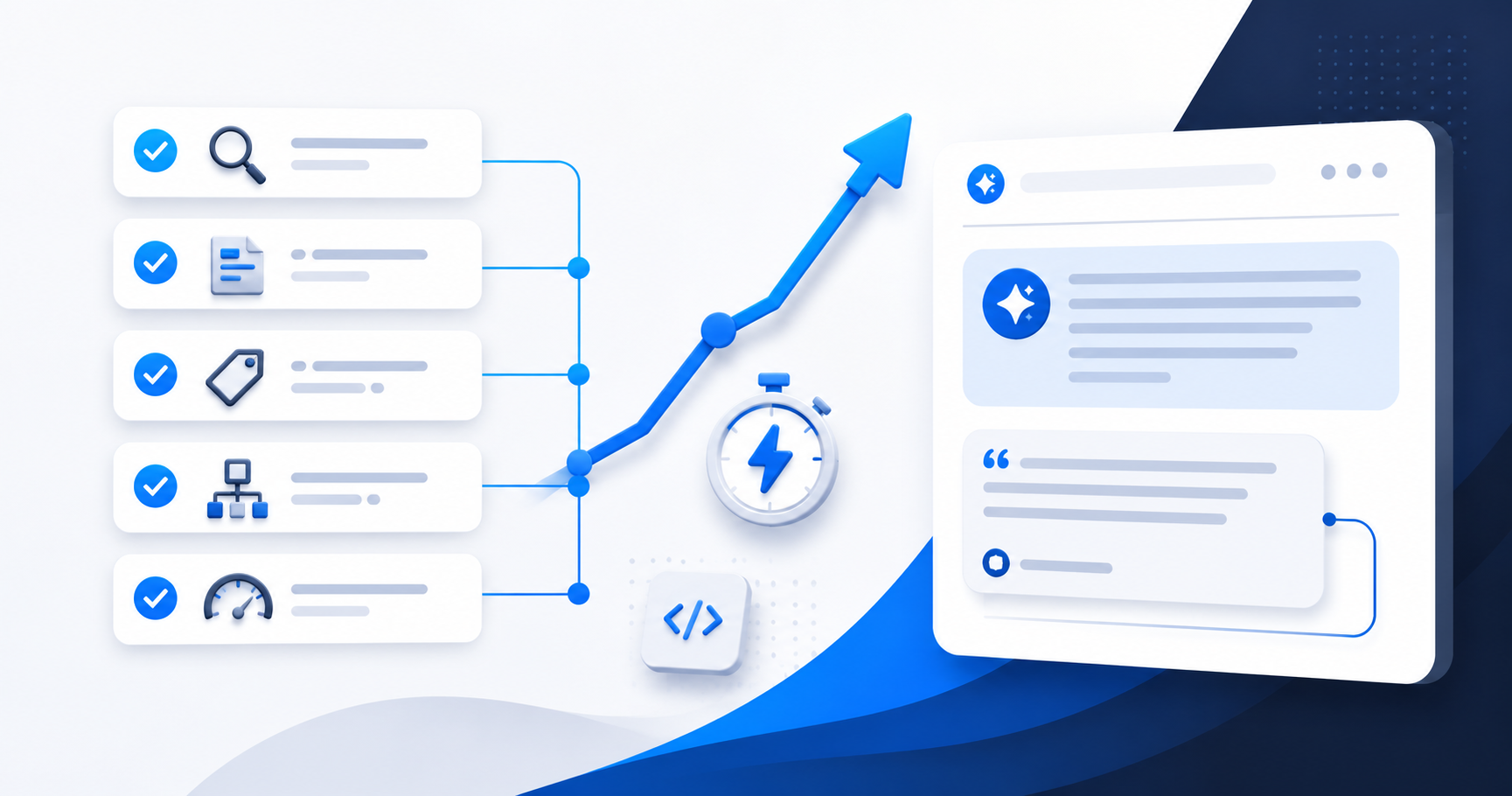
SEO quick wins for AI search come down to five high-impact optimizations you can make this week: format your content answer-first, add schema markup, sharpen your entity coverage, tighten your titles and meta descriptions, and mine Google Search Console for opportunities.
None require a developer or a full content overhaul, and Google’s own guidance on performing well in AI experiences points to the same fundamentals that drive traditional rankings.
The five tactics below sharpen your AI content optimization, slot into a modern AI SEO strategy, and can be implemented this week to help you rank in AI search across tools like Google AI Overviews, ChatGPT, Perplexity, and Gemini.
Do These This Week
5 SEO Quick Wins for AI Search
Answer-First Formatting
Lead each section with a clean, quotable answer.
Schema Markup
Add Article, FAQ, and Organization structured data.
Entity Coverage
Name entities and answer the full question set.
Titles & Meta
Tighten titles and descriptions to match intent.
Search Console Mining
Lift high-impression, low-CTR pages already in contention.
Search has changed: audiences now ask a question and read a synthesized answer instead of clicking ten blue links. That shift rewards pages that are easy for large language models to read, trust, and quote.
The good news: earning a citation in an AI answer does not require new skills, just a more intentional focus on structure, clarity, and making your best answer easy to extract.
What SEO Quick Wins Mean for Your AI SEO Strategy
SEO quick wins are low-effort, high-impact optimizations that move the needle in days or weeks rather than quarters. Think corrections and clarifications you can ship without a developer sprint or a content overhaul: a schema addition, a rewritten introduction, a cleaned-up heading structure.
In a traditional SEO program, these wins aim to improve Google’s organic rankings. In a modern AI SEO strategy, they serve a dual purpose. The same changes that help a page rank in classic search also make it easier for an AI engine to extract a clean, quotable answer, so you optimize one asset for two audiences at once without maintaining two separate playbooks.
It helps to understand how AI search actually pulls answers. Engines like Google AI Overviews and ChatGPT’s search parse a page for structure, extract discrete passages, weigh the source’s credibility, and synthesize a response that may cite several pages at once. This is the discipline often called answer engine optimization (AEO) or generative engine optimization (GEO): formatting and framing content so a machine can lift a confident, accurate answer from it.
A realistic timeline matters here, so let’s set expectations up front.
Set Expectations
How Fast Quick Wins Show Up
The five quick wins below are ordered roughly from highest-leverage to fastest-to-ship. You can tackle them in any order, but if you only do one this week, start with #1.
Quick Win #1: Format Content Answer-First for Answer Engine Optimization
The single fastest way to start earning AI citations is to lead with the answer. AI engines reward passages that state a clear, self-contained response near the top of a section, then expand on it.
Bury your answer under three paragraphs of throat-clearing, and you tell the model your content is hard to extract, so it quotes a competitor instead.
Here’s how to retrofit answer-first formatting onto existing pages in an afternoon:
- Add a 40-60 word direct answer immediately under each major heading. State the conclusion first; explain the reasoning after.
- Lead H2 and H3 sections with the question a user would actually ask, phrased in natural language (“How long does it take to rank in AI search?”) rather than a keyword fragment.
- Use short, declarative sentences for the core claim. Models extract clean sentences more reliably than clause-heavy ones.
- Break complex points into lists and tables. Structured passages are disproportionately likely to be lifted into AI answers.
- Front-load the value in the first 100 words of the page so the model encounters your best answer before it stops reading.
This is the heart of answer engine optimization: you are writing for a model that needs to quote you confidently, which is a higher bar than pleasing a keyword crawler. Pages that answer cleanly get cited, and the ones that meander get skipped.
This week’s action:
Pick your three highest-traffic pages and add an answer-first summary under each H2. It is the lowest-effort change on this list with the most direct line to an AI citation.
Quick Win #2: Add Schema Markup So AI Engines Can Parse You
Schema markup is structured data you add to a page to tell search and AI engines exactly what your content is: an article, a product, a how-to, an FAQ, an organization. To a large language model, schema is a labeled map of your page. Without it, the engine has to guess at meaning; with it, you remove the guesswork and increase the odds your content is understood and cited correctly.
You can implement the highest-value schema types in a single sitting:
- Article schema on every blog post, with author, publish date, and publisher clearly defined. Author and date signals feed the credibility checks AI engines run before citing a source.
- FAQPage schema on any page with a question-and-answer section. This maps your Q&As directly to how AI search retrieves answers.
- Organization schema sitewide, establishing your brand as a defined entity (more on entities in Quick Win #3).
- HowTo schema for step-by-step content, which AI engines frequently surface for procedural queries.
Use JSON-LD format, placed in the page head or body. Validate every change with Google’s Rich Results Test before publishing so a syntax error does not silently break the markup. Most CMS platforms and SEO plugins can generate baseline schema, but review the output rather than trusting it blindly.
This week’s action:
Add Article and FAQPage schema to your top ten pages and validate each one. This is a same-day technical win that often surfaces within days of a recrawl.
Quick Win #3: Sharpen Entity Coverage with AI Content Optimization
AI content optimization is the practice of structuring and framing content so AI engines recognize your expertise on a topic and trust you enough to cite it. The mechanism that matters most here is entities.
AI engines map the world as a network of entities (people, brands, concepts, places) and their relationships. To get cited in AI search, your content needs to clearly associate your brand with the entities relevant to your topic.
The quick-win version of this is straightforward:
- Name entities explicitly. Don’t write “the leading approach”; name the method, the tool, the standard. Specificity is what lets a model link your content to a known concept.
- Cover the related questions in one place. Use your preferred keyword research tool to pull the “Questions” and “Also rank for” terms around your topic, then make sure each relevant one is answered on the page. A thorough page reads as more authoritative to both Google and AI engines. The Ahrefs Keywords Explorer guide is a solid starting point for finding these fast.
- Strengthen internal linking around the topic. Link this page to and from your related cluster content so engines see a tight web of topical relevance rather than an orphaned article.
- Cite credible sources and add original data or examples. AI engines weigh expertise and trust; original insight is harder to ignore than rehashed advice.
This is where a dedicated agency partner earns its keep. At SEO Brand, our AI SEO services systematically build entity and topical authority, but the quick-win foundation above is something your team can start applying today.
Strong AI content optimization is less about volume and more about being the clearest, most complete, most credible answer on your subject.
This week’s action:
Choose one priority topic, pull its question set, and consolidate the answers onto a single well-structured page with explicit entity mentions and tight internal links.
Quick Win #4: Rewrite Title Tags and Meta Descriptions for AI Surfaces
Title tags and meta descriptions are still doing heavy lifting, including in AI search. Title tags help engines and models understand a page’s primary subject in seconds, and meta descriptions influence the click-through that follows an AI answer.
When an AI Overview cites you, a clear, compelling title is what earns the click once the user wants to go deeper.
The fixes here are genuinely five-minute jobs:
- Keep title tags to roughly 50-60 characters so they don’t get cut off in search results, and put the primary topic near the front.
- Write for clarity, not keyword stuffing. A title that reads naturally and states the page’s value performs better with users and with models parsing for relevance.
- Match the title to the actual question the page answers. Alignment between query, title, and on-page answer is a strong relevance signal.
- Write meta descriptions of 150-160 characters with a concrete value proposition and a light call to action. Even though descriptions aren’t a direct ranking factor, they shape the click decision after an AI engine surfaces you.
The point for AI search is consistency: when your title, your answer, and the user’s intent all line up, you become an easy, low-risk source for an engine to cite.
This week’s action:
Audit titles and descriptions on your top 20 pages. Rewrite any that are truncated, vague, or mismatched to the page’s core answer.
Quick Win #5: Mine Google Search Console for AI Search Opportunities
Google Search Console is the free tool that tells you where you already have momentum, and momentum is the easiest thing to convert into a quick win. Pages ranking on page two, or queries where you get impressions but few clicks, are your fastest opportunities: small improvements to content already in contention pay off faster than chasing brand-new topics.
If you haven’t already, the setup itself is a quick win: verify ownership, submit your XML sitemap, and confirm your key pages are indexed. From there, work the data:
- Filter the Performance report for high-impression, low-CTR queries. These are pages AI and traditional search already consider relevant; a better answer-first passage (Quick Win #1) or a sharper title (Quick Win #4) can lift them quickly.
- Find “tipping point” keywords ranking in positions 5-15 and improve those pages first.
- Use the URL Inspection tool to catch indexing and technical issues, and to request recrawls after you ship changes so they’re evaluated sooner.
- Watch for quick technical fixes GSC flags, such as mobile usability or Core Web Vitals issues, that can drag down otherwise strong pages.
GSC won’t show AI Overview citations directly, but it remains your best free signal for which pages are close to breaking through, and AI engines lean heavily on the same relevance signals you can see here.
This week’s action:
Pull your high-impression, low-CTR queries and apply Quick Wins #1 and #4 to the top five. Then manually request recrawls.
Measuring Your SEO Quick Wins in AI Search
Quick wins for AI search are only worth executing if you can prove they worked. Track impact across three layers so you can see results in days, not months:
- Traditional rankings and clicks in Google Search Console and your rank tracker, watching the specific pages and queries you optimized.
- Engagement and conversions in Google Analytics, to confirm the traffic you earn actually performs and drives business impact.
- AI search visibility, using an AI visibility or LLM tracking tool to monitor whether your brand is being mentioned and cited in AI Overviews, ChatGPT, Perplexity, and Gemini answers.
Apply these AI SEO best practices to every change
To keep results clean and repeatable, build a few AI SEO best practices into your workflow: change one major variable at a time so you know what moved the needle, log the date of every optimization so you can attribute lifts accurately, and re-check AI citations two to three weeks after shipping since models update on their own cadence.
Consistency in measurement is what turns a lucky win into a documented, repeatable AI SEO strategy.
Frequently Asked Questions
How long do SEO quick wins take to show results?
It depends on the type. Technical fixes like schema, title tags, and indexing corrections can surface within days of a recrawl. Content and formatting changes typically take one to three weeks. Larger ranking and authority shifts build over a month or more as engines re-evaluate your relevance.
What are the easiest SEO quick wins for beginners?
Start with the lowest-risk, highest-clarity changes: set up and verify Google Search Console, add answer-first summaries under your main headings, rewrite truncated or vague title tags, and add basic Article and FAQPage schema. None of these require development resources or a content overhaul.
Can SEO quick wins improve rankings immediately?
Some changes are visible quickly, but “immediate” is the wrong expectation. Technical fixes can be picked up in days once recrawled; content changes need time for engines to re-assess. Treat quick wins as fast rather than instant, and measure them over a two- to four-week horizon.
Which SEO quick wins have the biggest impact?
For AI search specifically, answer-first formatting and schema markup tend to deliver the most leverage, because they directly affect whether an engine can extract and trust a quotable answer from your page. Sharpening entity coverage compounds that over time.
How do I prioritize SEO quick wins for my website?
Prioritize by effort versus impact against your current gaps. If your content already ranks but isn’t getting cited, start with answer-first formatting and schema. If you have strong pages stuck on page two, work the Google Search Console opportunities first.
Start Ranking in AI Search This Week
You don’t need a quarter-long initiative to start showing up in AI answers. These SEO quick wins (answer-first formatting, schema markup, sharper entity coverage, cleaner titles and descriptions, and Google Search Console opportunity mining) are changes your team can execute in days and measure in weeks.
Pick one, implement it this week, and you’ll be one step closer to ranking in AI search while your competitors are still planning their roadmap.
If you are ready to scale this beyond quick wins, SEO Brand’s AI SEO services build the entity authority and answer-engine readiness that keep you cited as AI search evolves. Request your free proposal today.