Schema markup for AI search is a useful way to improve local visibility today, as AI overviews and chatbots reshape how people find information. If you have been investing in schema markup for SEO and wondering whether it still matters in an AI-first world, it does.
This guide explains how structured data supports AI search optimization, which schema types matter most, how to implement them step by step, and the mistakes that may hinder your visibility.
What Is Schema Markup? (A Quick Refresher)
Schema markup is structured data. It is code added to a page to help search engines and AI systems understand the content, context, and relationships on that page. Instead of leaving interpretation to the search engine, schema provides explicit, machine-readable labels.
Schema.org is the shared vocabulary that makes this possible. It is backed by Google, Bing, Yahoo, and Yandex, and it defines thousands of entity types and properties.
In traditional SEO, schema markup has powered rich results like star ratings, FAQ dropdowns, and event dates in the SERP. These features improve both visibility and click-through rates.
Its role is now expanding in a more fundamental way. AI-powered search tools are moving away from returning ranked lists of links toward synthesizing answers that pull from multiple sources.
In this model, schema markup does something different: it helps search systems and some AI features understand who you are, what you offer, and whether your business is the right entity to surface for a given query.
That distinction matters when your business is competing for a citation in a generated answer rather than a position on a results page.
How AI Search Engines Use Structured Data to Answer Local Queries
When someone asks Google AI Overviews, ChatGPT, or Perplexity a local question, these systems extract structured information from multiple sources and synthesize it into a response. Schema markup can provide machine-readable context that may improve how systems interpret a page.
Entity disambiguation sits at the center of that process. AI needs to know exactly which business, person, or place a page refers to. Take our own Boca Raton office at 150 East Palmetto Park Road as an example. Schema markup gives AI systems the structured context to identify us as a specific entity (our location, our services, and our authority in that market). Strip that away, and AI systems are left to infer. Inferences produce omissions. Omissions produce invisibility.
It is worth being precise here about what is confirmed versus assumed.
Google’s Search team confirmed in April 2025 that structured data provides an advantage in search results. Microsoft’s principal product manager for Bing confirmed in March 2025 that schema markup helps their LLMs understand content for Copilot.
For platforms like ChatGPT, Perplexity, and others, the picture is less clear. Those companies have not disclosed whether they preserve the schema during crawling or use it for extraction. The technical capability exists, but confirmation has not been published.
Schema markup also connects to Google’s Knowledge Graph, a large database of entities and relationships that underpins AI Overviews and local search features.
Accurate, well-structured data strengthens your presence in that system, thereby increasing the likelihood that your business is cited in AI-generated answers, surfaced in voice search, and named in chatbot responses where those systems use structured data.
For AI visibility for local businesses, structured data is now a core signal.
Why Schema Markup for Local Business AI Visibility Matters Now
Local businesses face a growing challenge. The queries that drive foot traffic and phone calls (especially near me queries) are now, more often than not, answered directly by AI-generated results.
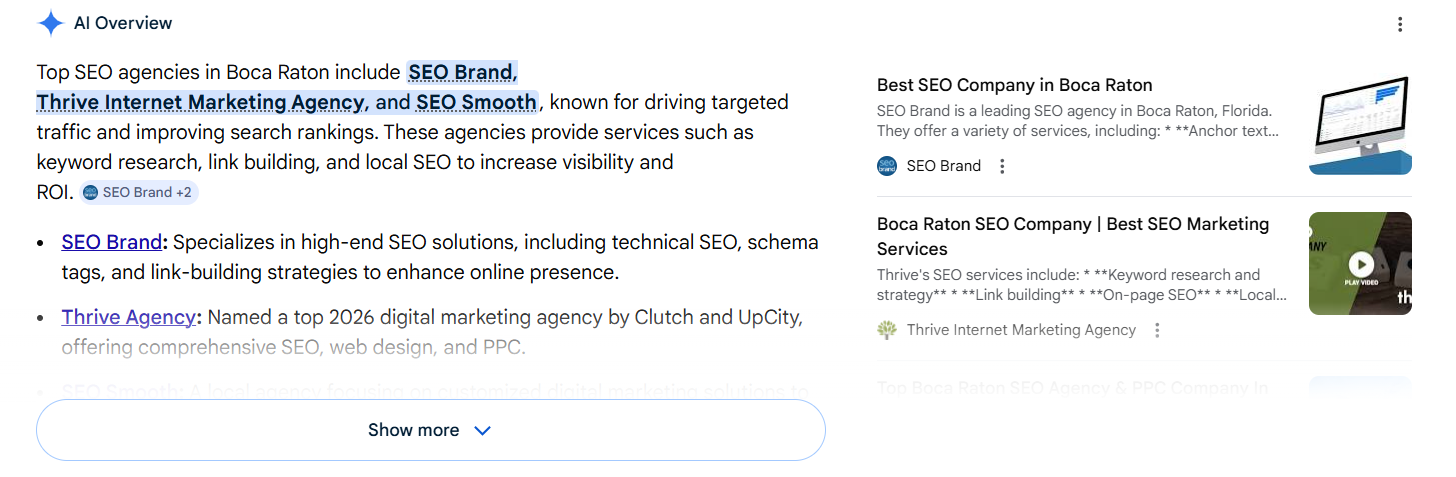
A user asking for the best dry cleaner nearby may never see a standard list of links. They may see a brief AI-synthesized answer that names two or three businesses. If you are not among them, you lose that customer before they reach your site. We’ve seen this play out in our own results. Our Boca Raton service page surfaces by name in Google’s AI Overview for searches like “top SEO agencies in Boca.” There are likely a variety of factors at play, but structured data is one of them, and it illustrates exactly why local businesses need to give AI systems clear, accurate signals about who they are and where they operate.
This is also why LocalBusiness schema is important. When implemented correctly, it communicates your business name, address, service area, hours, phone number, accepted payment methods, services, and aggregate ratings in a format AI systems can read quickly and unambiguously. You are giving the AI explicit facts rather than expecting it to infer them from unstructured prose.
For enterprise brands with many locations, the stakes are even higher. Inconsistent structured data across location pages creates confusion. Mismatched addresses, outdated hours, and conflicting service details can cause AI systems to ignore or deprioritize those listings. A template-based schema across all location pages helps you maintain local visibility at scale.
The outcomes matter. Structured data may improve the chances that your business details are interpreted correctly and shown in search features, including some AI-generated experiences where supported. A strong local SEO strategy now needs structured data at its core, and schema markup for AI helps connect your real-world business to the systems that generate answers.
The Most Important Schema Types for AI Optimization
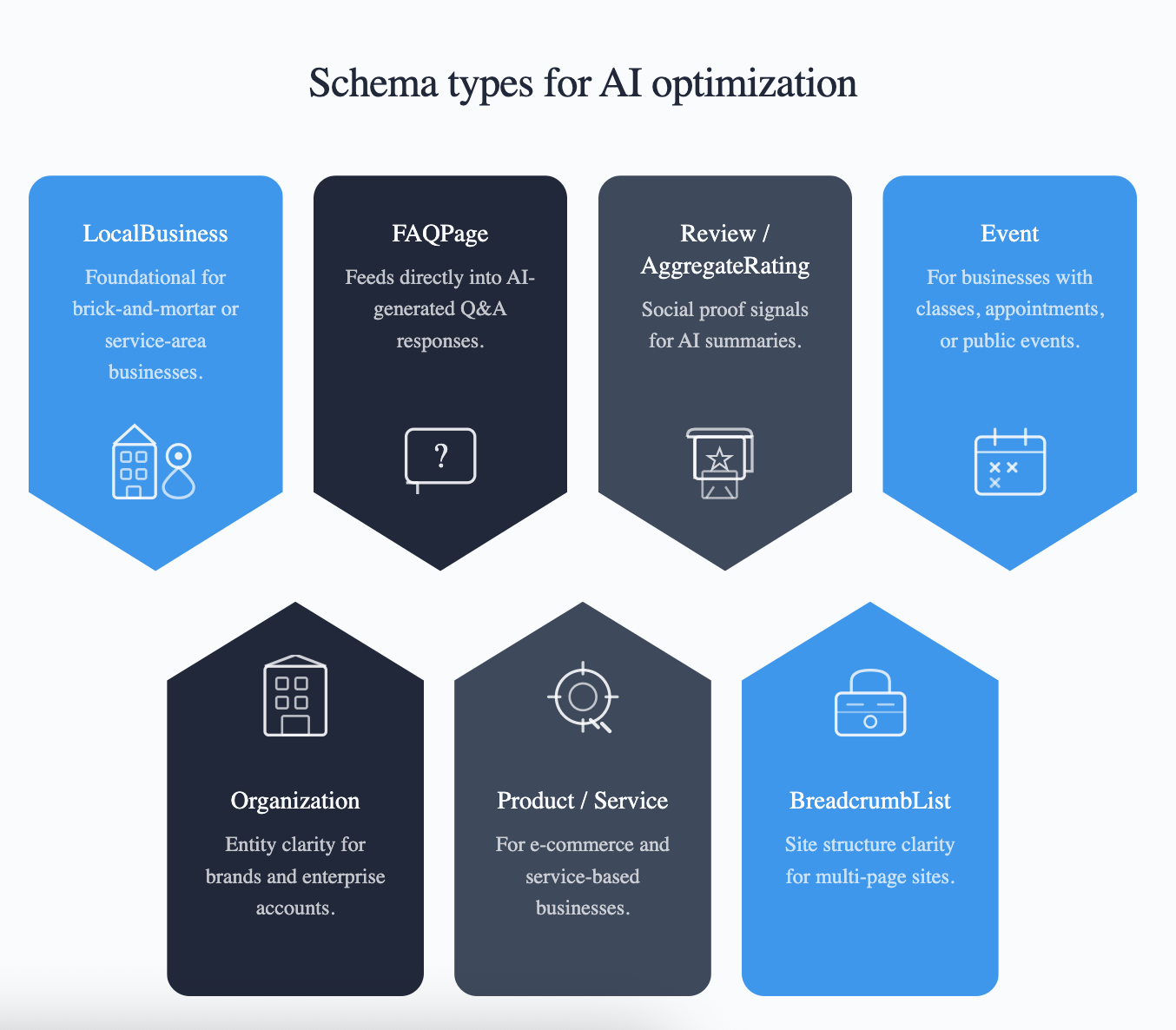
Not all schema types carry the same weight for schema markup for AI optimization. These are the seven types you should prioritize, in order of impact for most businesses.
LocalBusiness
LocalBusiness is the foundation for any brick-and-mortar or service-area business. It clearly communicates your name, address, phone number, hours, and service categories to AI systems. Every business with a physical location or defined service area should start here.
json

   {

     "@context": "https://schema.org",

     "@type": "LocalBusiness",

     "name": "Sunrise Bakery",

     "address": {

       "@type": "PostalAddress",

       "streetAddress": "123 Main St",

       "addressLocality": "Austin",

       "addressRegion": "TX",

       "postalCode": "78701",

       "addressCountry": "US"

     },

     "telephone": "+1-512-555-0100",

     "openingHours": "Mo-Fr 07:00-18:00",

     "url": "https://www.sunrisebakery.com"

   }
Organization Schema
Organization supports brand-level entity clarity. It tells AI systems who your company is at the corporate level, including logo, social profiles, founding details, and official website.
For multi-location brands, this anchors each location-level LocalBusiness to a single parent entity, reducing the risk of fragmented brand identity across AI knowledge systems.
FAQ Page Schema
FAQPage helps feed AI-generated Q&A responses. When AI Overviews synthesize answers to informational queries, the FAQPage schema gives them pre-structured question-and-answer pairs to draw from.
This can be one of the highest-value implementations for businesses that publish customer education content.
   {

     "@context": "https://schema.org",

     "@type": "FAQPage",

     "mainEntity": [{

       "@type": "Question",

       "name": "What hours are you open?",

       "acceptedAnswer": {

         "@type": "Answer",

         "text": "We are open Monday through Friday, 7am to 6pm."

       }

     }]

   }
Product / Service
Product / Service communicates what you sell, what it costs, and how it is rated. Search engines can use structured data to better understand products, services, and local business details.
Review / AggregateRating
Review / AggregateRating provides social-proof signals that AI may reference for local recommendations. An accurate AggregateRating schema helps AI surface your rating correctly when assembling ranked suggestions.
BreadcrumbList
BreadcrumbList shows the site structure and content hierarchy. It is especially helpful for multi-page and multi-location sites because it helps AI understand how your pages relate to one another.
Event Schema
Event schema is important for businesses hosting classes, workshops, or public events. It helps AI surface time-sensitive offerings and improves discoverability for appointment-based services.
How to Build an Entity Graph
Traditional SEO schema treats each page as a standalone object, an Article here, an Organization there, with no formal connections between them. For AI search, the more powerful pattern is to connect those objects into a coherent entity graph using the @id property.
A @graph-based implementation works by giving each entity a stable, unique identifier that other entities can reference. An Organization node holds your brand identity. A Person node for each author references that Organization via worksFor. An Article node references both the author and the publisher, and declares its main topics via the about property. The result is a small internal knowledge graph that AI systems can traverse to understand who owns the content, who is responsible for it, and what it is about.
json

{

  "@context": "https://schema.org",

  "@graph": [

    {

      "@id": "https://example.com/#organization",

      "@type": "Organization",

      "name": "Example Digital"

    },

    {

      "@id": "https://example.com/#person-jane-doe",

      "@type": "Person",

      "name": "Jane Doe",

      "worksFor": { "@id": "https://example.com/#organization" }

    },

    {

      "@type": "Article",

      "@id": "https://example.com/blog/schema-markup-ai-search",

      "headline": "Schema Markup for AI Search",

      "author": { "@id": "https://example.com/#person-jane-doe" },

      "publisher": { "@id": "https://example.com/#organization" }

    }

  ]

}

For any AI system that preserves JSON-LD during crawling, this pattern removes ambiguity about brand identity, authorship, and topical authority regardless of how page layout or copy changes over time. It also improves consistency across a multi-location site, because every location page can reference the same parent Organization @id.
How to Implement Schema Markup (Step-by-Step)
Implementing schema markup for SEO and AI search follows a repeatable process. These steps apply whether you use a plugin, a CMS template, or Google Tag Manager.
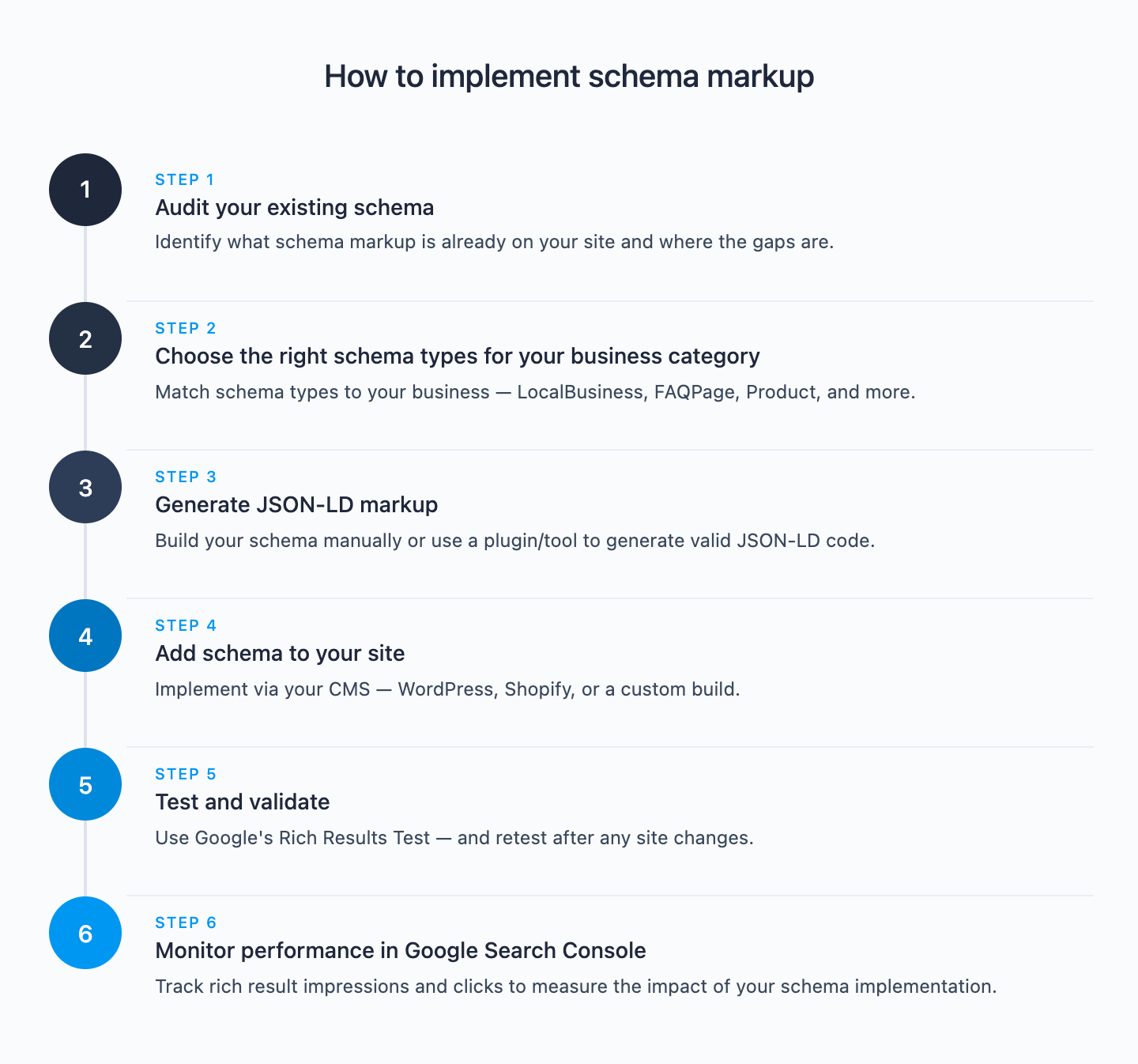
- Audit your existing schema: Before adding anything new, review what is already on the site. Use Google’s Rich Results Test and the Schema Markup Validator to identify existing markup, errors, and gaps across key pages.
- Choose the right schema types for your business: Use the priority list above as your starting point. A local restaurant may need the LocalBusiness, AggregateRating, and Menu schemas. A law firm may need LocalBusiness, Organization, and Service. The schema should match the real business and the actual page content.
- Generate JSON-LD markup: Enterprise teams should build reusable JSON-LD templates with consistent @id values for deployment in Google Tag Manager or a CMS. Smaller teams can use tools like Yoast SEO, Rank Math, Schema Pro, or Google’s Structured Data Markup Helper as a starting point, though these tools often generate isolated markup rather than a connected entity graph. Review the output accordingly.
- Add schema to the site: Place the JSON-LD inside a <script type=”application/ld+json”> tag in the <head> of the relevant page. WordPress plugins can handle this automatically. Shopify sites can use theme.liquid or a structured data app. Custom sites should inject the markup through the CMS or tag manager layer.
- Test and validate: Run the Rich Results Test after publishing. Check for errors and warnings. Redesigns, new service pages, and updated hours can all affect structured data, so retest when pages change.
- Monitor in Google Search Console: The Enhancements section tracks rich result impressions and errors by schema type. This helps you confirm that markup is being read and flags issues as they emerge.
Common Schema Mistakes That Hurt AI Visibility
Even well-intentioned schema markup for AI can hurt local visibility when common errors go unresolved. Structured data with mistakes does more than fail to help. It can confuse AI systems and create policy issues.
- Marking up content that is not visible on the page. Google requires structured data to reflect content that users can actually see. Marking up reviews that do not appear on the page or listing hours that differ from what the page shows can create policy issues and reduce rich result eligibility.
- Inconsistent NAP data. Name, address, and phone number need to match across schema markup, the website, Google Business Profile, and third-party citations. Mismatches create ambiguity and weaken confidence in the business entity.
- Using outdated or deprecated schema types. Schema.org changes over time. Types and properties that worked before may no longer apply. Always check Schema.org and Google’s developer documentation for current guidance.
- Failing to update the schema when business details change. New hours, a new address, added services, or a phone number update all require corresponding schema updates. Stale structured data can lead to incorrect AI citations.
- Only adding schema to the homepage. The homepage is only one page. Service pages, location pages, product pages, and blog posts with FAQ content can all benefit from targeted schema.
- Using Microdata or RDFa instead of JSON-LD. Google recommends JSON-LD for structured data. It is easier to maintain and update, and less prone to implementation errors than inline microdata or RDFa.
Frequently Asked Questions
What is schema markup for AI search engines?
Schema markup is structured data that helps AI search engines understand the context, entities, and relationships in web content. It goes beyond keyword matching, giving AI a clearer semantic understanding of what a page says. That clarity helps AI overviews and chatbots cite businesses more accurately in local and informational answers.
How does schema markup improve local visibility?
The LocalBusiness schema signals a business name, location, hours, services, and customer ratings in a format that AI systems can process quickly. That helps reduce ambiguity when an engine builds a local recommendation or answer. Businesses with a complete and accurate LocalBusiness schema are more likely to be cited in AI-generated answers, appear in map pack results, and surface in voice search responses.
What is the best schema markup for AI optimization?
For most businesses, the LocalBusiness, FAQPage, and Organization schemas provide the greatest value. LocalBusiness supports entity and location signals. Organization gives AI better brand-level clarity. FAQPage supports AI Q&A generation. The right mix depends on the business type. E-commerce sites should also prioritize Product and AggregateRating schema. Service businesses should add the Service schema.
Do small businesses need schema markup to appear in AI search results?
Yes. Implementation is more accessible than ever. No-code plugins like Yoast SEO, Rank Math, and Schema Pro can handle much of the technical work. Google’s Structured Data Markup Helper also works across platforms. As AI search takes up more of the result page, schema markup can help determine which businesses get cited and which are overlooked.
Is JSON-LD the best format for schema markup for SEO?
Yes. JSON-LD is Google’s recommended schema markup format for SEO and the best choice for new implementations. It does not require changes to existing HTML. You can add it as a separate script block, which makes it easier to maintain, update, and validate.
How often should I update my schema markup?
Update schema markup whenever business details change, including hours, address, services, or phone number. It’s also important to run a full schema audit at least once each quarter. Quarterly audits help catch deprecated properties, schema-live content mismatches, and gaps on new pages. Enterprise teams can also use Google Search Console enhancement reports to spot issues between audits.
Use Schema Markup for AI Search and Take Control of Your Local Visibility
AI search is here, and it is changing how local businesses get discovered, cited, and chosen. Schema markup for AI is one of the most practical investments you can make to help your business appear in AI-generated answers, map packs, and voice search results. The steps are clear, the tools are accessible, and the visibility impact is measurable.
For small businesses implementing schema markup for SEO for the first time and for enterprise teams standardizing structured data across many locations, now is the time to act.
The businesses that move now will build an AI visibility advantage that grows over time. Explore our AI SEO services at SEO Brand or contact us for a free proposal to see how we can help your business win in AI search.