Most enterprises do not fail at SEO because they lack talent or budget. They fail because their SEO function relies on heroics rather than frameworks. Every migration becomes a fire drill. Every product launch breaks a template nobody documented. Every quarterly review reports traffic, not revenue.
This guide covers what a real enterprise SEO strategy looks like, the five pillars of a scalable framework, the step-by-step build process, how to measure ROI in a way the CFO takes seriously, and the mistakes that stall growth even for well-resourced teams. For an overview of how SEO Brand approaches this work, see our enterprise SEO services.
What Is an Enterprise SEO Strategy?
An enterprise SEO strategy is the long-term, organization-wide plan that governs how a large brand earns organic visibility across a site with hundreds of thousands – or millions – of URLs. It defines the standards, workflows, and measurement systems that keep SEO consistent across product lines, regions, and teams, no matter how fast the business is moving underneath it.
The word that does the real work in that definition is framework. Think of it as an assembly line rather than a custom shop. A custom shop can produce one exceptional piece. An assembly line produces thousands of consistent ones. At enterprise scale, you need the assembly line. A framework turns individual SEO wins into a repeatable system – so the same decisions get made the same way every time, by different people, on different continents, on different schedules. Visibility compounds instead of decaying.
At SEO Brand, we have ranked more than 100,000 pages on Google across our 20+ years in business, and every enterprise-scale engagement we have ever run starts with the same question: Does this organization have a framework, or just a list of tactics? See our about page for more on how we build these systems.
Why One-Off SEO Tactics Break at Enterprise Scale
Small-business SEO rewards speed and creativity. A single landing-page rewrite, a batch of backlinks, or a well-placed blog post can move the needle in weeks. A scalable SEO strategy for enterprise organizations does not work like that.
At enterprise scale, the surface area is too large for a tactical approach to keep up. In any given week on a typical enterprise site, all of this is happening simultaneously:
- Product teams are launching new SKUs with new URL patterns.
- Regional teams are localizing content into new markets.
- Engineering is deploying a framework upgrade that changes how pages render.
- PR is running a campaign that sends thousands of inconsistent backlinks to subfolders that nobody is tracking.
- A third-party tag manager update quietly breaks structured data across 40,000 pages.
Each of those events is manageable on its own. All five happening in the same week is the reality of enterprise SEO – and the reason reactive teams lose ground. You cannot out-hustle that volume. You can only out-systematize it. That shift from doing SEO to operationalizing SEO is what a framework provides.
The Five Pillars of a Scalable Enterprise SEO Framework
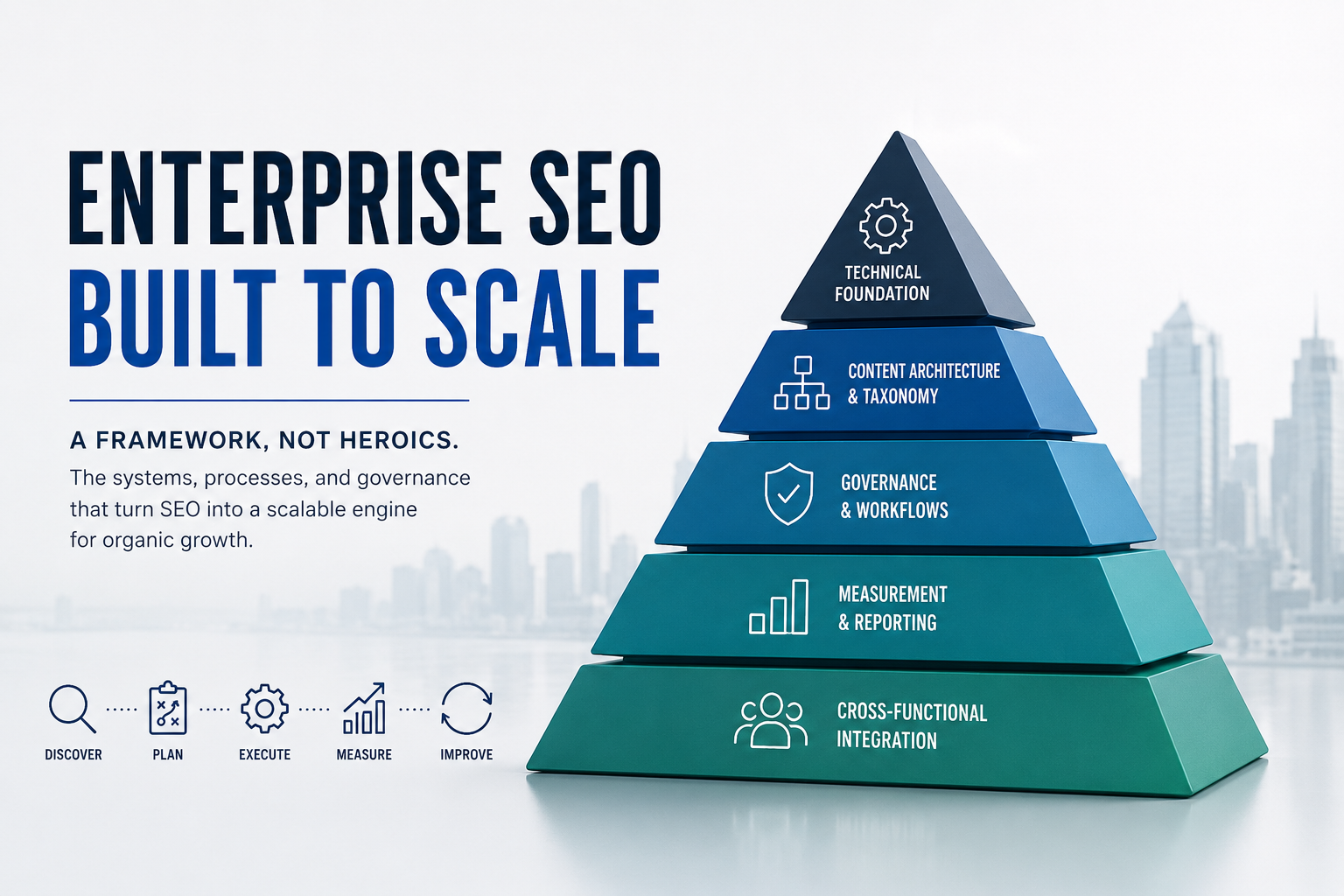
Every durable enterprise SEO strategy rests on the same five pillars. A framework missing any one of these will not scale.
1. Technical SEO Foundation
Crawlability, indexability, site speed, and render stability at scale. On a two-million-URL site, a 1% crawl-waste rate is not a rounding error – it is 20,000 pages Google never sees. This pillar covers log-file analysis, internal link equity distribution, and rendering consistency across CDNs and JavaScript frameworks. Tools like Botify and BrightEdge are purpose-built for this layer.
2. Content Architecture and Taxonomy
A defensible topical map, owned content hubs, clear URL hierarchies, and templates that any team can populate correctly. At scale, content architecture is what prevents keyword cannibalization and accidental duplication across regions and product lines. This is also where an enterprise content strategy begins – not with individual posts, but with the map those posts inhabit.
3. Governance and Workflows
Who approves new URL patterns? Who owns redirects? How a page gets QA’d before publication. Where the rollback plan lives when something breaks. Governance is the least glamorous pillar and the one that separates enterprises that recover from a migration in days from those that recover in months. It is also the pillar most competitors neglect entirely.
4. Measurement and Reporting
A single source of truth for organic performance wired to business outcomes (revenue, pipeline, customer acquisition cost), not just rankings and sessions. For how this measurement model extends to AI-driven search, see our primer on answer engine optimization.
5. Cross-Functional Integration
SEO sits at the intersection of product, engineering, content, PR, and paid media. A scalable framework defines the specific touchpoints where SEO earns a seat at the table: sprint planning, release reviews, content briefs, and campaign kickoffs. Without that, enterprise technical SEO and content work becomes reactive – cleaning up after decisions it was never consulted on.
Enterprise SEO vs. Mid-Market and Small-Business SEO
The differences go deeper than scale. Enterprise SEO is a distinct discipline with its own success metrics, and trying to run it like a scaled-up version of SMB SEO is one of the most expensive mistakes a large brand can make.
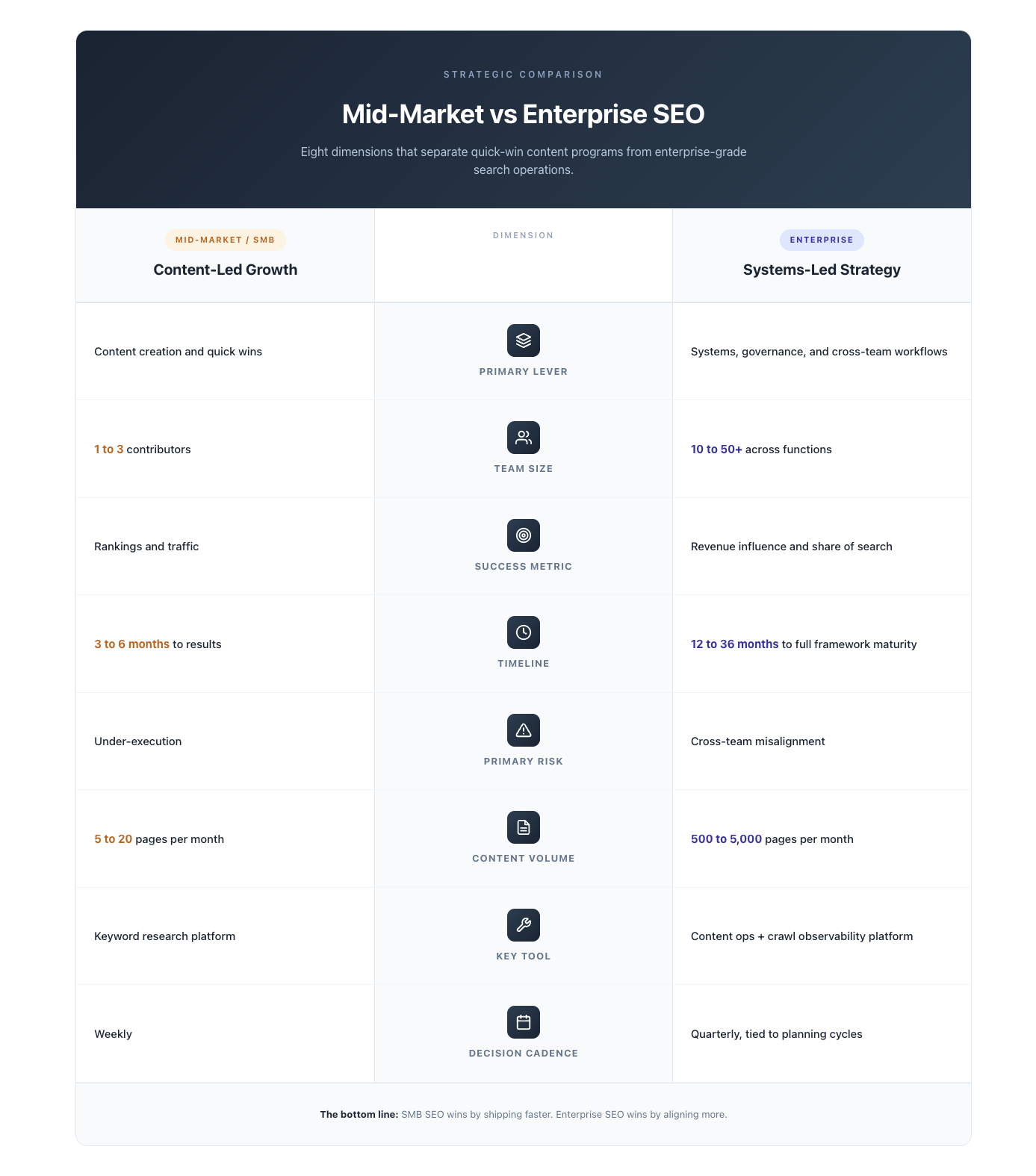
The operating model is what changes. SMB SEO rewards the best individual contributor. Enterprise SEO rewards the team that has made the work reproducible. Our professional SEO services cover the mid-market approach for teams that are not yet at enterprise scale.
How to Build an Enterprise SEO Framework (Step-by-Step)
Every scalable framework follows the same progression. You do not need to execute every step perfectly before results appear – but you do need to address them in order.
- Audit the current state honestly. Start with a technical audit covering crawl efficiency, indexation quality, Core Web Vitals, rendering, and structured data coverage at URL scale – not sample scale. Layer in content inventory, topical coverage, and competitive share-of-voice. The goal: one document any leader can open and understand in 20 minutes.
- Define the topical architecture. Map your addressable market to identify a hub-and-spoke structure aligned with how the business is actually organized. Identify the pillars you must own, the pillars you need to defend, and the ones to deprioritize. This is the step where enterprise SEO diverges hardest from SMB – you are drawing the map for the next three years, not the next quarter.
- Codify the standards. Write down the URL patterns, internal linking rules, metadata requirements, schema templates, content brief structures, and QA checkpoints. This becomes your team’s onboarding doc, your agency’s scope of work, and your engineering requirements spec – all in one.
- Instrument measurement. Wire organic performance data to the business outcomes that matter to the C-suite: revenue, pipeline, LTV, and CAC. Build the reporting cadence before you start reporting.
- Pilot on a contained slice. Pick one product vertical, one region, or one content hub. Apply the framework end-to-end. Learn what breaks. Document the gaps.
- Scale the rollout and formalize governance. Expand systematically – never faster than your governance structure can keep up. Build the RACI model, name the owners, and establish the sprint rituals, ensuring SEO has a seat at the table.
Our content marketing services integrate directly into Step 3, providing brief templates and editorial standards to ensure consistency in large-scale content production.
Enterprise SEO Management: Tools, Teams, and Technical Debt
Frameworks do not run themselves. Enterprise SEO management is the operational layer that keeps the framework alive once it is built.
A mature enterprise SEO function typically runs on:
- An enterprise SEO platform for auditing, rank tracking, and content intelligence – tools like BrightEdge, Conductor, and Botify are purpose-built for this layer.
- A content operations platform to manage briefs, drafts, and approvals across distributed writers and regional teams. At enterprise scale, this is what keeps localized and regional content production from drifting into chaos.
- A log-file analysis tool to understand what search engines are actually crawling, not what you assume they are crawling.
- Dedicated BI tooling that ties organic data to revenue – Looker, Tableau, or a custom stack on top of your data warehouse.
The team composition matters as much as the tooling. Enterprise SEO best practices point toward a blended model: in-house strategists who own the framework, agency partners who bring scale and specialized expertise, and embedded technical support close to engineering. Our link-building services operate inside this blended model, handling authority acquisition while internal teams focus on framework governance.
Then there is technical debt. Every enterprise site has it. Legacy URL structures, orphaned redirect chains, deprecated schema, and abandoned subdomains quietly erode your framework. A scalable enterprise SEO strategy includes a quarterly debt-paydown cycle – not glamorous, but non-negotiable.
Measuring the ROI of Your Enterprise SEO Strategy
This is where enterprise SEO earns its budget – or loses it.
Ranking reports and session counts will not survive a CFO review. What does survive is a measurement model that connects organic search to pipeline and revenue, shows where the framework is generating incremental growth, and projects the return on continued investment. The three enterprise SEO ROI metrics that matter most in a C-suite conversation:
- Organic revenue influence: the revenue attributable to organic search across first-touch, last-touch, and multi-touch attribution models.
- Share of search: your visibility against named competitors across the keywords driving your category’s demand.
- Cost per incremental organic session – the real unit economics of your SEO program over time, not a vanity metric.
According to McKinsey’s Rewired and running ahead research, digital and AI leaders are pulling away from their peers in growth and shareholder returns, with banking digital leaders posting an 8% annual TSR compared with 5% for laggards. The framework is what lets you report against these numbers consistently, quarter after quarter, without having to reinvent the measurement model with each leadership change.
Common Enterprise SEO Mistakes That Stall Scalable Growth
Even well-resourced enterprise SEO programs hit the same ceilings. These are the patterns we see most often:
- Treating SEO as a channel instead of a discipline. SEO cuts across product, content, engineering, and PR. Siloing it within a single team guarantees cross-functional misalignment that kills scalable growth.
- Optimizing without governance. Launching new URL patterns or content hubs without documented standards creates duplicate content, cannibalization, and hygiene problems that compound faster than you can fix them.
- Measuring rankings instead of revenue. Ranking movements are leading indicators, not outcomes. A framework that reports only on rankings becomes the line item the CFO cuts first.
- Scaling content before fixing technical foundations. Publishing 5,000 new pages onto a crawl-wasted site only amplifies existing weaknesses. Fix enterprise technical SEO first.
- Ignoring internal linking at scale. At enterprise volume, internal links are your single largest lever for distributing authority. Most organizations treat them as an afterthought.
- Under-investing in AI search readiness. Google AI Overviews, ChatGPT, and Perplexity are already re-routing traffic away from traditional rankings. According to research from Princeton’s Generative Engine Optimization study, generative engines reward different optimization signals than traditional search, including citation density, statistical specificity, and authoritative quotation, and content optimized for those signals can lift visibility in AI-generated responses by up to 40%.
An enterprise SEO framework built only for ten blue links is already behind. See our AI SEO services for how we approach this shift.
Frequently Asked Questions: Enterprise SEO Strategy
What is the difference between an enterprise SEO strategy and regular SEO?
An enterprise SEO strategy is built around frameworks, governance, and cross-functional workflows because the site is too large for a tactical approach. Regular SEO focuses on individual pages and campaigns. Enterprise SEO focuses on the systems that produce those pages and campaigns consistently across hundreds of thousands of URLs – and connects that output to revenue rather than just rankings.
How long does an enterprise SEO framework take to build?
A working enterprise SEO framework typically takes 90 to 120 days to build and pilot, with full rollout across an enterprise site extending 12 to 18 months. Results usually start compounding after month six, once governance, measurement, and content standards are all operating in parallel.
What are enterprise SEO best practices for scaling content?
Template-driven content with rigorous brief standards and clear editorial QA. Every content unit should be produced against a brief that specifies target keywords, internal links, schema requirements, and quality criteria. Without templates and briefs, content volume becomes a liability rather than an asset – each piece amplifies inconsistencies instead of building topical authority.
How do we measure the ROI of our enterprise SEO strategy?
Tie organic performance to revenue, pipeline, and customer acquisition cost rather than rankings or sessions alone. Build a single source of truth for SEO performance, report quarterly against business outcomes, and maintain a share-of-search view against named competitors. This gives leadership the clear signal they need to continue investing in the framework.
Should enterprise SEO be run in-house or through an agency?
The most effective enterprise SEO programs use a blended model: in-house strategists who own the framework and business context, paired with an agency partner for scale, specialized expertise in areas like enterprise technical SEO and AI SEO, and delivery capacity. Pure in-house and pure agency models both have structural blind spots that a blended approach resolves.
How does AI search change enterprise SEO strategy?
AI search adds an entirely new optimization layer to the framework. Traditional ranking optimization is no longer sufficient – enterprises must now optimize for AI citations in ChatGPT, Google AI Overviews, and Perplexity in parallel with traditional search. The framework must include entity clarity, structured data at scale, and content built for direct answer extraction rather than just keyword ranking.
Build the Enterprise SEO Strategy Your Growth Actually Requires
AI search is already changing how enterprise brands get found. The brands that will own category visibility over the next five years are not the ones with the biggest content budgets – they are the ones with the most systematized enterprise SEO strategy.
You do not need to overhaul everything at once. Start with an honest audit, define your topical architecture, and build the governance layer that makes everything else repeatable. Every compounding organic win from that point forward is the framework paying off.
SEO Brand has been building enterprise-scale SEO frameworks for 20+ years – and has ranked more than 100,000 pages and driven over $50M in attributed sales in the process. If you are ready to move from tactics to a system, get a free proposal or explore our full enterprise SEO services to see how we build scalable frameworks.