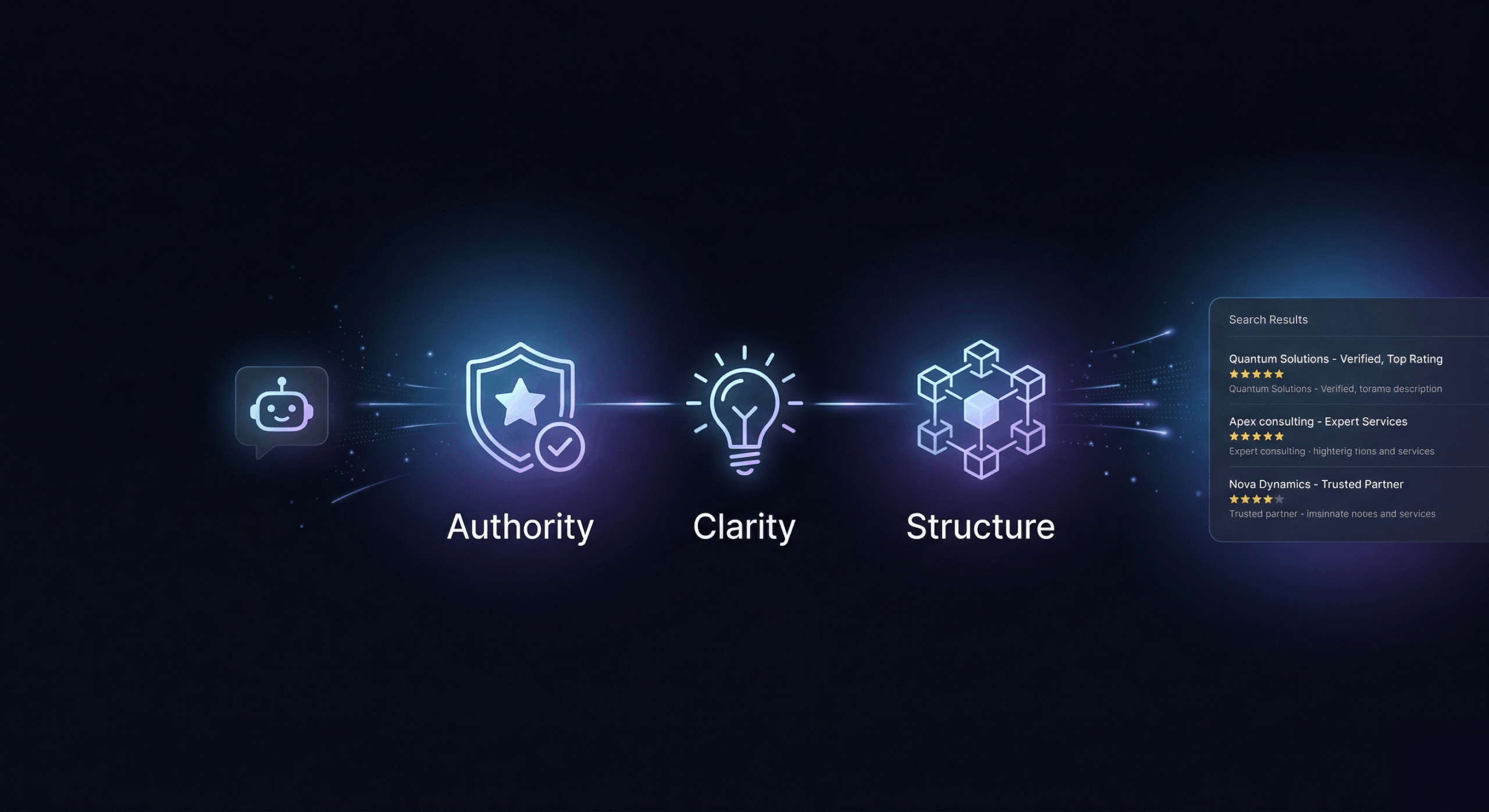
Pro Tips for Boosting Brand Visibility in AI Search Results (and Why It Matters)
To optimize for ChatGPT, your website needs authority, clarity, and structured data that AI systems can extract and cite. Most businesses built their visibility strategy around Google. That’s worked well in the past, and it’s still a crucial piece of the digital marketing puzzle now. But the game has changed.
ChatGPT, Perplexity, and Google’s AI Overviews don’t return a list of blue links. They generate an answer. If your brand isn’t named in that answer, you don’t exist for that user. No click. No visit. No lead.
The good news: you don’t need to be a developer to fix this. This guide covers exactly how to optimize for ChatGPT search, whether you’re a solo business owner or an enterprise marketing team.
Google Gets You Clicked. ChatGPT Gets You Cited. Here’s the Difference.
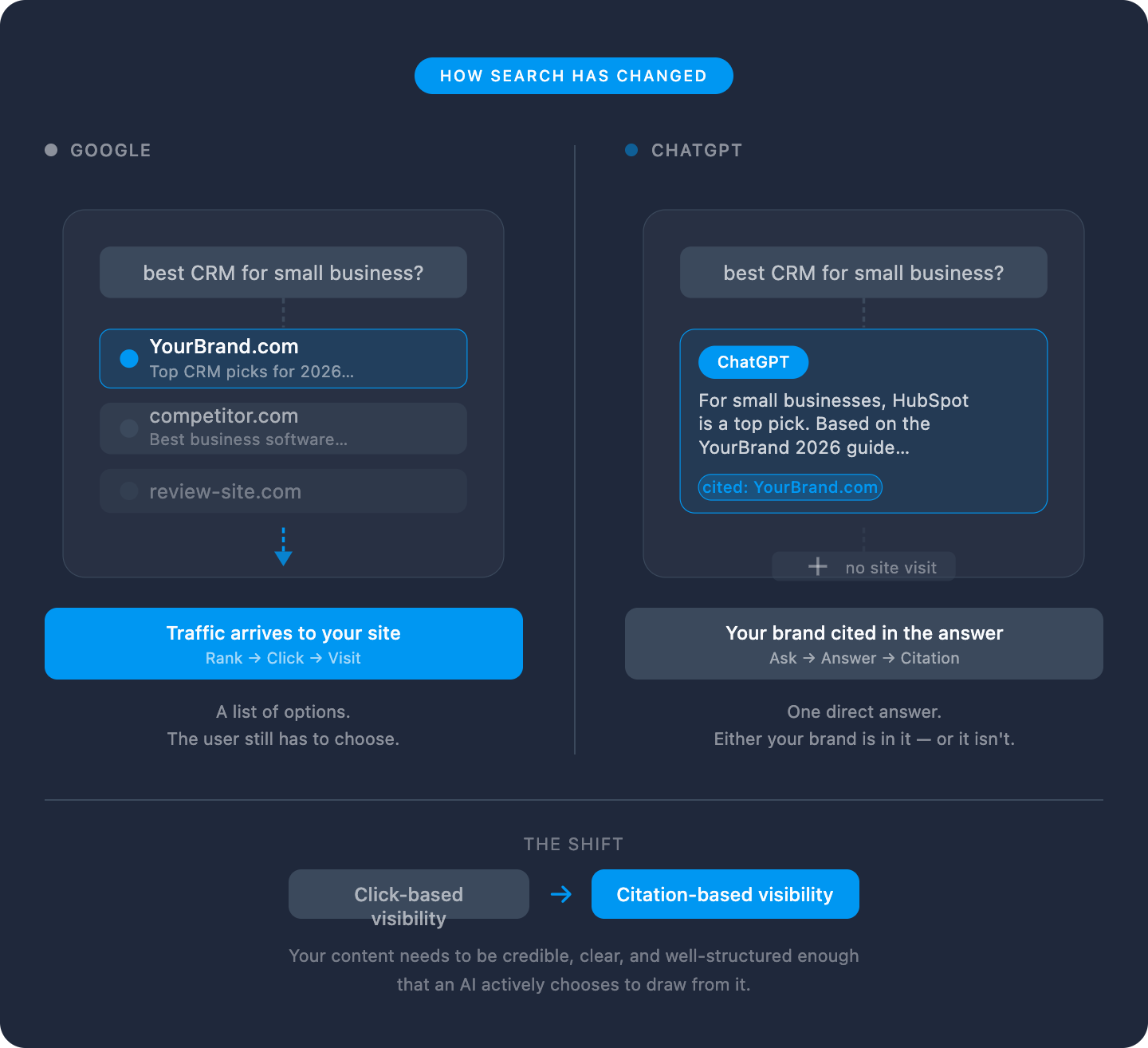
Google is a referral engine. You rank, users click, traffic arrives. Basic math.
ChatGPT works differently. Ask it a question, and it generates a direct answer. The user gets what they need without ever visiting a website. There’s no page two. No ranked list. Just the answer, and either your brand is in it, or it isn’t.
Think of it this way: Google is a library catalog that points readers to books. ChatGPT is your coworker who has already read them and can give you the “TL;DR”-summary on the spot. If your content wasn’t in the books that your coworker read, your name doesn’t come up.
That shift from click-based search to citation-based search changes everything. Your content needs to be credible, clear, and well-structured enough that an AI system will actively draw from it.
Understanding this difference is step one. Optimizing for it is step two.
Optimize for ChatGPT: Three Principles That Drive Citations
Every tactic in this guide connects to one of three things. Get these right, and the rest follows.
1. Authority
ChatGPT favors sources it recognizes as credible. Authority comes from signals across the web: backlinks from respected publications, consistent brand mentions in third-party sources, and a site that clearly communicates who you are. If AI can’t confidently identify your brand as a legitimate entity, it defaults to one it can.
2. Content Clarity
AI systems extract information from your content. Bury the main point under three paragraphs of context, and the model may skip your page entirely. Clarity means direct answers, short paragraphs, and plain language that’s easy to identify and pull from.
3. Content Structure
Structure tells AI systems what your content is about and how it’s organized. Clear headings, logical hierarchy, and schema markup give AI a reliable map of your site. Less ambiguity means a higher chance that the right content gets matched to the right query.
The Technical Foundation: What ChatGPT Needs to Trust Your Site
Before AI can cite your content, it has to find and read it. To optimize for ChatGPT and other LLMs effectively, these are the technical basics that signal your site’s trustworthiness.
Crawlability and Site Architecture
Your site should be easy to crawl: clean URLs, no broken links, an updated XML sitemap, and a robots.txt that isn’t accidentally blocking key pages. A logical content hierarchy helps AI systems understand how your pages relate to each other.
Page Speed
Slow pages hurt you everywhere. Run your site through Google PageSpeed Insights. Most of the fixes it surfaces can be handled without touching a line of code.
Your About Page
Wildly underestimated. Your About page should state your business name, location, areas of expertise, and how long you’ve been operating. ChatGPT uses that information to verify you’re a real, established entity. Vague or outdated? You’re leaving a major trust signal on the table.
NAP Consistency
NAP: Name, Address, Phone number. These should be identical across your website, Google Business Profile, and every directory listing. Inconsistencies create confusion for AI systems trying to verify your identity.
Schema Markup
Schema is structured data added to your site’s code that tells AI systems exactly what your content means, not just what it says. It’s one of the most direct levers for optimizing your website for ChatGPT. We’ll cover it in depth later.
Enterprise teams: run a centralized audit of NAP data and schema across all location pages before anything else. Consistency at scale is the challenge.
SMB owners: WordPress, Squarespace, and Wix all have plugins that handle most of this without a developer. Rank Math and Yoast are solid starting points.
Write It So AI Can Use It: Content That Gets Cited
This is where most businesses have the biggest opportunity. ChatGPT doesn’t cite content for being well-written in a general sense. It cites content that directly answers a question. Here’s how to structure yours.
Lead With the Answer
Put the direct response at the top of each section, then follow with context and detail. If your page buries the definition in paragraph four, the AI will pull from a page that doesn’t. Answer-first writing is the single biggest structural shift you can make.
Use Descriptive Headings
H2 and H3 headings should describe exactly what each section covers, using language that mirrors how your audience actually asks questions. They help AI map your content and pull the right section for the right query.
Format for Skimmability
Use bulleted and numbered lists for processes, comparisons, and multi-part answers. Short paragraphs. No walls of text. This works for AI readability and for mobile readers at the same time.
Add FAQ Sections
Direct Q&A pairs are highly effective for AI citation. Each answer should stand alone in two to four sentences, no setup required. Apply FAQPage schema to these sections (more on that below), and you’re giving AI systems an unambiguous signal about what type of content this is.
Write for People, Rank With AI
AI systems are trained on human content and are good at detecting writing optimized purely with keywords for search engines. Topical depth beats keyword density. Aim for a Grade 8 to 10 reading level. Define technical terms when you use them. Write like you’re explaining something to a smart client who’s new to your industry.
Go Deep on Your Topics
One thorough page outperforms several thin ones every time. To increase visibility in ChatGPT, specificity and depth matter. Be the most useful resource in your subject area.
How to Improve Brand Mentions in ChatGPT Responses: Build Authority Off-Site
ChatGPT is more likely to name your brand when it has a credible presence across the web, not just on your own site. Your website is one input. Your off-site footprint matters just as much.
Earn Quality Backlinks
Links from high-authority publications, industry associations, and news sources signal that your brand is recognized as an expert. Quality beats quantity here. One mention in a respected trade publication does more than dozens of low-value directory links.
Get Named in Third-Party Sources
Google reviews, Clutch listings, press coverage, podcast appearances, and guest bylines all build a richer off-site presence. These mentions help AI systems confirm that your brand is real, relevant, and worth citing.
Lock Down Your Brand Entity
Your business information should be accurate and consistent across Google Business Profile, LinkedIn, Crunchbase, and Wikipedia (if applicable). AI models use these sources to construct your brand entity: a coherent picture of who you are. Gaps and inconsistencies show up as uncertainty in AI-generated answers.
Build Topical Authority
Publishing consistently on a specific subject signals to AI systems that your brand is a go-to source for that topic. LLM optimization rewards depth and consistency over time. Pick your core areas and own them.
Enterprise teams: digital PR at scale is one of the most powerful levers for improving brand mentions in ChatGPT responses. Align your content and PR calendars to drive a concentrated volume of mentions around your key topics.
SMB owners: start accessible. Fully complete your Google Business Profile, get listed in relevant local directories, and ask satisfied clients to leave detailed reviews that mention your specialty and service area.
Schema Markup: The Fastest Technical Win for ChatGPT Visibility
Schema is structured data added to your HTML that gives AI systems clear, unambiguous information about your content. Instead of leaving a model to infer what your page is about, schema tells it directly: this is the business, this is the FAQ section, this is the product.
To optimize a website for ChatGPT, schema is critical because it removes guesswork. It’s the most direct technical signal you can send.
Common Key Schema Types to Implement
- Organization: identifies your business, including name, URL, logo, location, and contact details.
- FAQPage: flags your FAQ sections as structured Q&A pairs, making them highly extractable for AI-generated answers.
- Article: tells AI systems a page is editorial content, with metadata like author, publish date, and headline.
- LocalBusiness: essential for any business with a physical location or service area. Confirms your entity details to local and AI search systems.
- Product / Service: describes what you offer, with pricing, descriptions, and relevant attributes.
You don’t need to write the schema by hand. Rank Math and Yoast generate it automatically for WordPress. Validate what’s live with Google’s Rich Results Test.
For a full walkthrough of schema markup for AI search, see our dedicated guide.
Measuring What You Can’t See: Tracking Your ChatGPT Visibility
Here’s the frustrating reality: ChatGPT doesn’t show up in your analytics the way Google does. Visits from AI tools typically arrive as direct traffic with no referral attribution. This is sometimes called dark traffic, and right now, it’s the norm.
Measurement is still catching up. Here’s what you can do today:
- Test manually: search your brand name and top service keywords in ChatGPT monthly. Note whether you’re mentioned, how you’re described, and which sources appear alongside you.
- Watch Bing referrals: ChatGPT’s browsing feature pulls real-time content through Bing. A rise in Bing referral traffic is a meaningful signal. Set up Bing Webmaster Tools if you haven’t.
- Use emerging AI tools: Semrush and Ahrefs are rolling out features to monitor brand mentions in LLMs. Dedicated AI visibility platforms are launching rapidly.
- Set up Google Alerts: brand name and key service term alerts surface new web mentions, including content AI systems are likely to index.
The gap between brands investing in AI visibility and those ignoring it is growing. The tracking tools will mature. Build the visibility now.
How to Optimize for ChatGPT Search: FAQs
Q: How long does it take to see results from ChatGPT search optimization?
Most businesses see meaningful gains in AI visibility within two to six months. Authority signals, such as backlinks and brand mentions, compound over time. Faster wins like schema markup and answer-first content restructuring can shift how AI tools reference your brand within weeks.
Q: Do I need to be technical to optimize my website for ChatGPT?
No. Most foundational optimizations are handled by standard CMS plugins. Rank Math and Yoast handle schema automatically. PageSpeed Insights gives plain-language action items. The 20% of technical work that drives 80% of results, schema, crawlability, and a complete About page, is all achievable without a developer. For site architecture audits or custom schema types, that’s when a specialist makes sense.
Q: Is optimizing for ChatGPT the same as optimizing for Google?
There’s real overlap: quality content, domain authority, and structured data matter for both. The key difference is the goal. Google optimization earns clicks from a ranked list. ChatGPT optimization earns citations in a generated answer, which places greater emphasis on entity clarity, answer-extractable formatting, and off-site brand presence. A strong SEO foundation is a good starting point, but AI search has its own requirements.
Q: What content types perform best in ChatGPT search results?
How-to guides with numbered steps, FAQ pages, comparison articles, and authoritative topic explainers perform best. Content that leads with a direct answer and uses clear H2 and H3 headings is most likely to be cited. Thin, keyword-stuffed pages without a clear answer structure perform poorly.
Q: How do I improve my brand’s chances of being mentioned in ChatGPT responses?
To improve brand mentions in ChatGPT responses, focus on three things: keep your brand entity consistent across your site and third-party sources, earn mentions and backlinks from credible publications, and build topical authority through consistent publishing. Organization schema also helps AI systems confidently identify and reference your brand.
Q: Does ChatGPT use my website directly, or does it go through another source?
ChatGPT’s web browsing feature retrieves live content through Bing, not Google. Your Bing indexation matters, just like Google Search Console. Verify your site is indexed in Bing Webmaster Tools and that Bing can access your key pages. ChatGPT’s base model also draws on its training data, which is why off-site brand presence, third-party mentions, and press coverage shape how the model represents you.
Stop Waiting. Your Competitors Aren’t.
AI search is already changing how businesses get found. The brands building ChatGPT visibility now are creating an advantage that compounds over time. You don’t need a full strategy overhaul to start. Lead with content clarity, add schema markup, and lock down a consistent brand presence across the web. Partnering with an established agency that offers AI SEO services is a solid first step.
Ready to see exactly where your AI search opportunities are? Get your free proposal from SEO Brand.