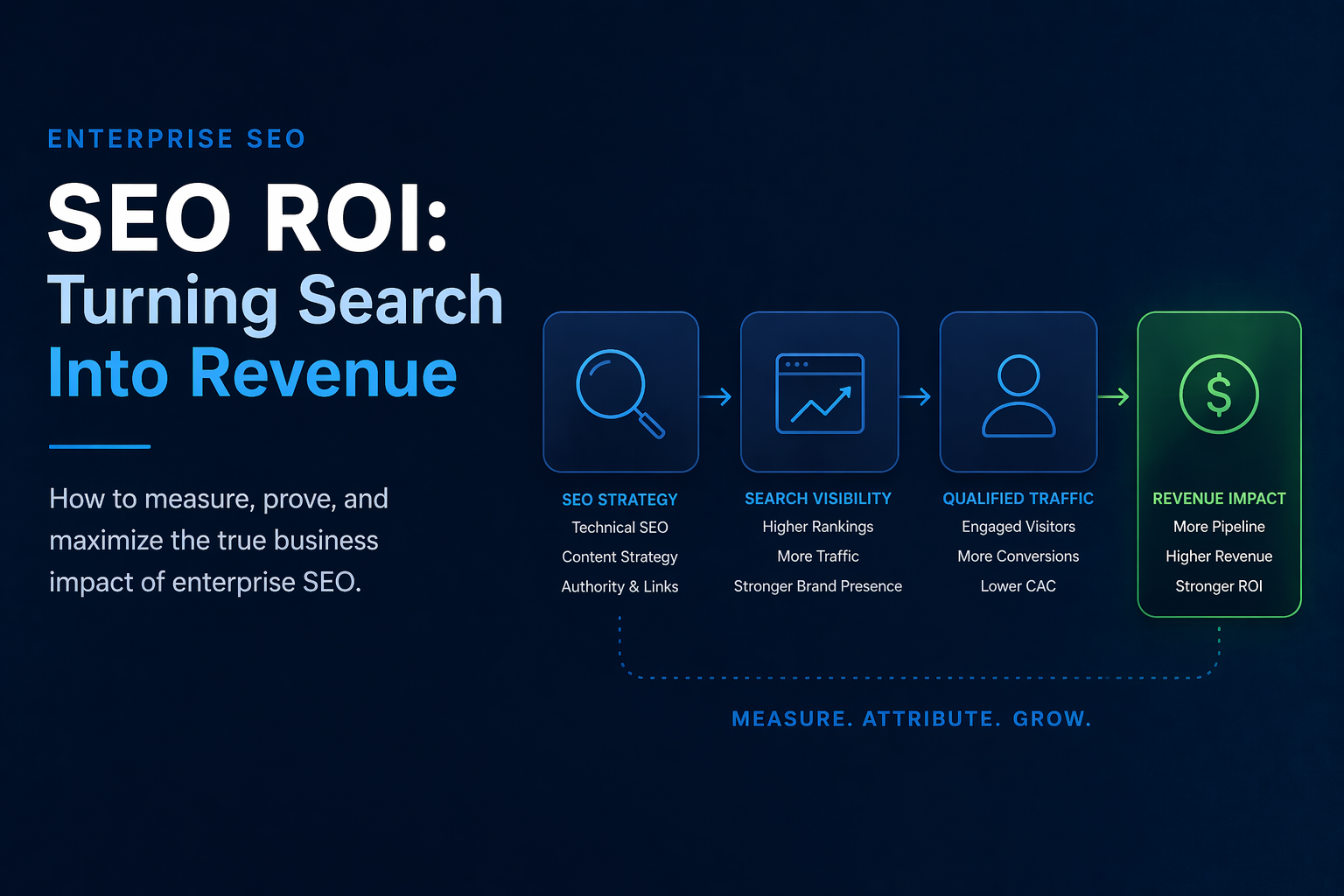
Enterprise SEO is often misunderstood as a traffic channel, when in reality it is a revenue engine. The real value of SEO at scale is not rankings or sessions, but its ability to drive pipeline, reduce acquisition costs, and create compounding business growth. Understanding enterprise SEO ROI is simply the mechanism for proving that impact.
At its core, enterprise SEO ROI is calculated as (Revenue minus Investment) divided by Investment, multiplied by 100. But for large organizations, this calculation only matters if it clearly answers one question:
Why Enterprise SEO Is a Revenue Driver, Not a Marketing Tactic
In enterprise environments, customer journeys are complex and rarely linear. A single conversion may involve multiple interactions across channels over weeks or months. Organic search frequently serves as the initial discovery channel, shaping demand before any measurable conversion occurs.
This means SEO influences far more than last-click revenue. It impacts:
- Pipeline generation by capturing high-intent demand early
- Brand authority, which increases conversion rates across channels
- Paid media efficiency by lowering the cost per acquisition
- Long-term customer value through sustained visibility
When viewed through this lens, SEO is one of the few channels that simultaneously improve top-line growth and marketing efficiency.
The Role of ROI in Connecting SEO to Business Outcomes
ROI is not the goal. It is the bridge between SEO activity and executive decision-making.
Most organizations calculate ROI by looking only at direct conversions from organic traffic. This approach significantly undervalues SEO because it ignores assisted conversions and long-term revenue impact.
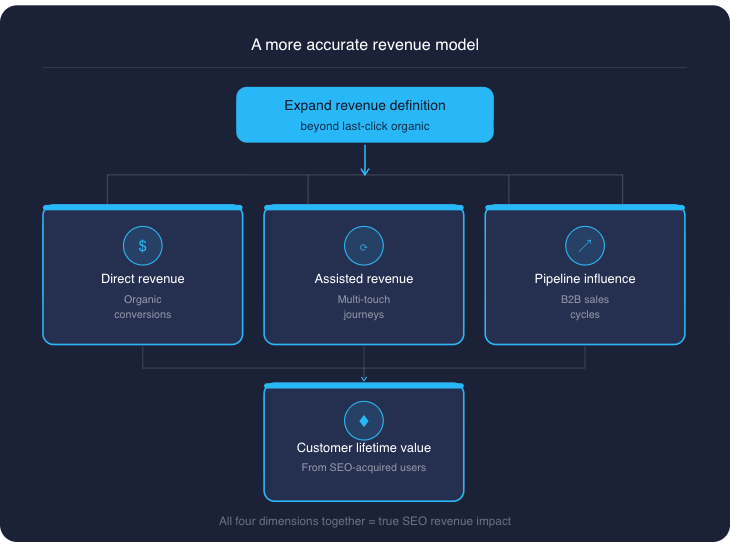
When these factors are taken into account, enterprise SEO consistently emerges as one of the highest-return investments in the marketing mix.
Measuring Search Investment the Right Way
To connect SEO to revenue, investment must be measured with equal precision. Many enterprise teams underestimate SEO costs by focusing only on agency retainers or internal headcount.
In practice, SEO investment spans multiple areas:
- Strategic and executional resources across SEO, content, and engineering
- Technology platforms for tracking, optimization, and reporting
- Content production designed to capture demand across the funnel
- Technical implementation required to scale across large websites
Without accounting for this full ecosystem, ROI calculations lose credibility. Accurate measuring of search investment is essential for gaining executive trust and securing long-term budget.
Attribution: The Missing Link Between SEO and Revenue
Attribution is the most critical factor in demonstrating Fortune 500 SEO ROI. Traditional models fail because they oversimplify the user conversion process.
Last-click attribution, still widely used, ignores the role SEO plays in early-stage discovery. As a result, SEO appears less valuable than it actually is.
Modern enterprise organizations are shifting toward more advanced models:
- Multi-touch attribution that distributes value across interactions
- Data-driven attribution that reflects actual user behavior
- CRM-integrated tracking that connects SEO to closed revenue
This shift allows organizations to move beyond channel-level reporting and understand how SEO contributes to pipeline, deal velocity, and overall business growth.
How to Measure ROI on Enterprise SEO Campaigns
Understanding how to measure ROI on enterprise SEO campaigns requires aligning SEO performance with business outcomes from the start.
The process is not about tracking more metrics. It is about tracking the right ones and connecting them to revenue.
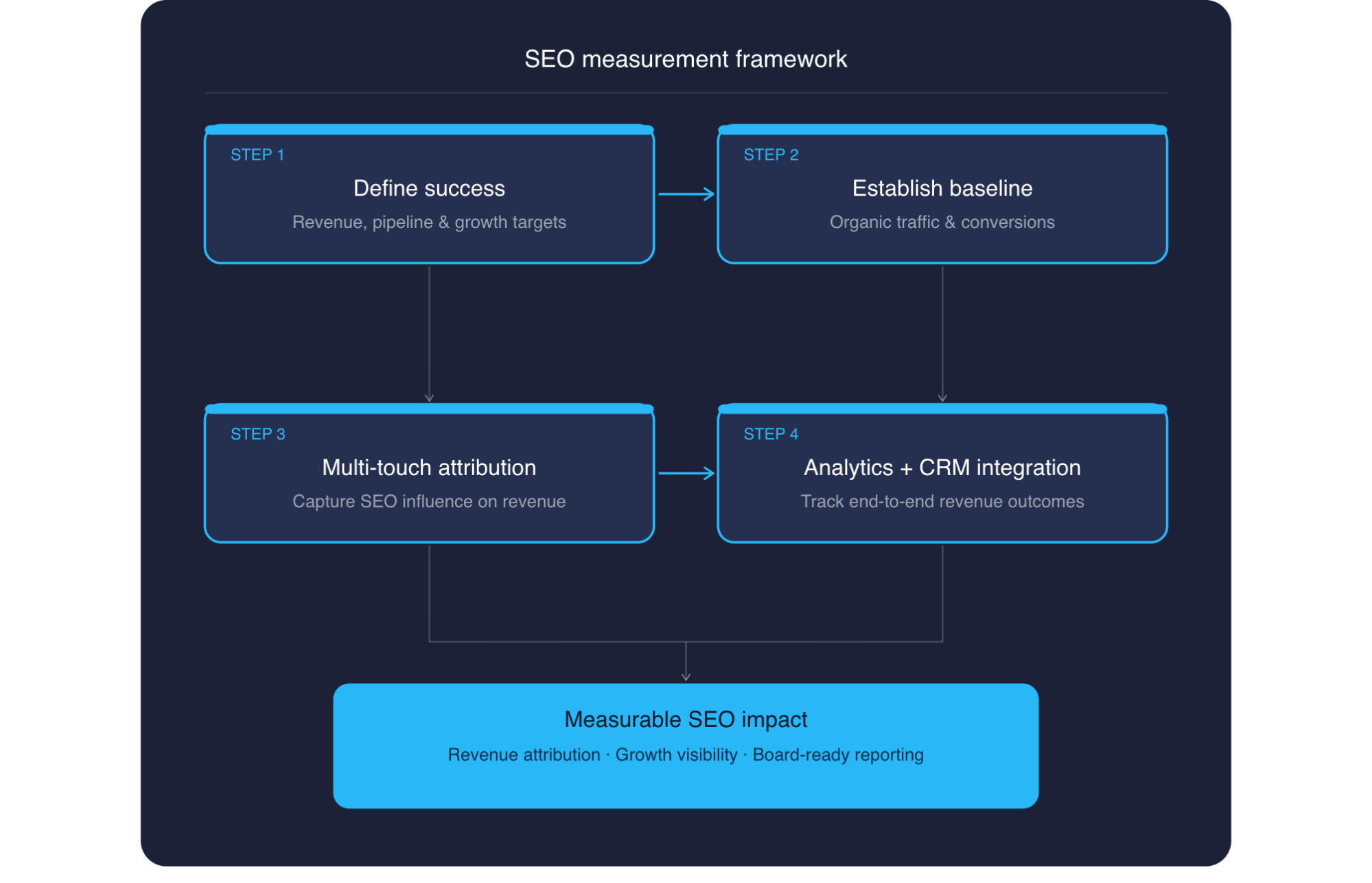
The key is focusing on incremental impact. This isolates SEO’s contribution and provides a clear view of how it drives growth over time.
AI Search and the Next Evolution of SEO ROI
Search is evolving, and so is how ROI should be measured. AI-driven platforms are changing how users discover and evaluate brands, introducing new layers of visibility that traditional analytics often miss.
This shift is driving the rise of Generative Engine Optimization, where success is measured not only by traffic but by presence in AI-generated responses and brand-level authority.
For enterprises, this creates new opportunities to improve ROI:
- Capturing high-intent users earlier in the decision process
- Increasing brand visibility across emerging search environments
- Driving higher-quality traffic with stronger conversion potential
These changes are among the most important ways to boost ROI through enterprise SEO, particularly for organizations that adapt early.
Ways to Boost ROI Through Enterprise SEO
Improving ROI requires a deliberate focus on revenue-driving activities, not just visibility. Enterprise SEO performs best when it is aligned with business outcomes, ensuring that every initiative contributes directly to growth rather than isolated metrics.
This starts with prioritizing high-intent keywords that drive revenue, while improving conversion rates through a stronger user experience and optimized landing pages. At the same time, maintaining a solid technical foundation ensures maximum visibility and prevents missed opportunities.
To scale results, SEO must be aligned with broader business objectives and supported by proven enterprise-level strategies. When executed correctly, SEO moves beyond traffic generation and becomes a consistent driver of measurable business outcomes.
SEO as a Scalable Growth Engine
Enterprise SEO ROI is not just a metric. It is a framework for understanding how search contributes to revenue and long-term business growth.
Organizations that succeed treat SEO as a core growth function. They align it with revenue objectives, invest in the right infrastructure, and continuously optimize performance based on business impact.
When executed correctly, enterprise SEO becomes more than a marketing channel. It becomes a scalable, compounding engine for revenue growth.
Frequently Asked Questions: Enterprise SEO and Revenue Growth
What is enterprise SEO ROI?
Enterprise SEO ROI measures the return generated from organic search compared to the total investment. It is calculated as (Revenue minus Investment) divided by Investment, multiplied by 100. At scale, it also includes assisted conversions, pipeline influence, and customer lifetime value.
How does enterprise SEO drive revenue?
Enterprise SEO drives revenue by capturing high-intent demand, increasing brand visibility, and influencing decisions across the customer journey. It contributes to pipeline growth, improves conversion rates, and reduces reliance on paid channels.
Why is SEO often undervalued in enterprise organizations?
SEO is often undervalued because many companies rely on last-click attribution, which ignores its role in early-stage discovery and multi-touch journeys. This leads to underreporting its true impact on revenue and growth.
How long does it take to see ROI from enterprise SEO?
Enterprise SEO typically requires 6 to 12 months to show measurable impact and 12 to 18 months to fully scale. However, once it gains momentum, it becomes a compounding growth channel with long-term returns.
What metrics matter most for enterprise SEO success?
The most important metrics are revenue from organic search, pipeline contribution, customer acquisition cost, and lifetime value. These align SEO performance with business outcomes rather than vanity metrics.
How does AI search impact enterprise SEO ROI?
AI search changes how users discover information, shifting focus from clicks to visibility and influence. Enterprises must now track presence in AI-generated results and optimize for brand authority, not just rankings.
What is the best way to improve enterprise SEO ROI?
The most effective approach is to align SEO with revenue goals, target high-intent keywords, improve conversion rates, and strengthen technical performance. When combined, these efforts turn SEO into a scalable growth engine.