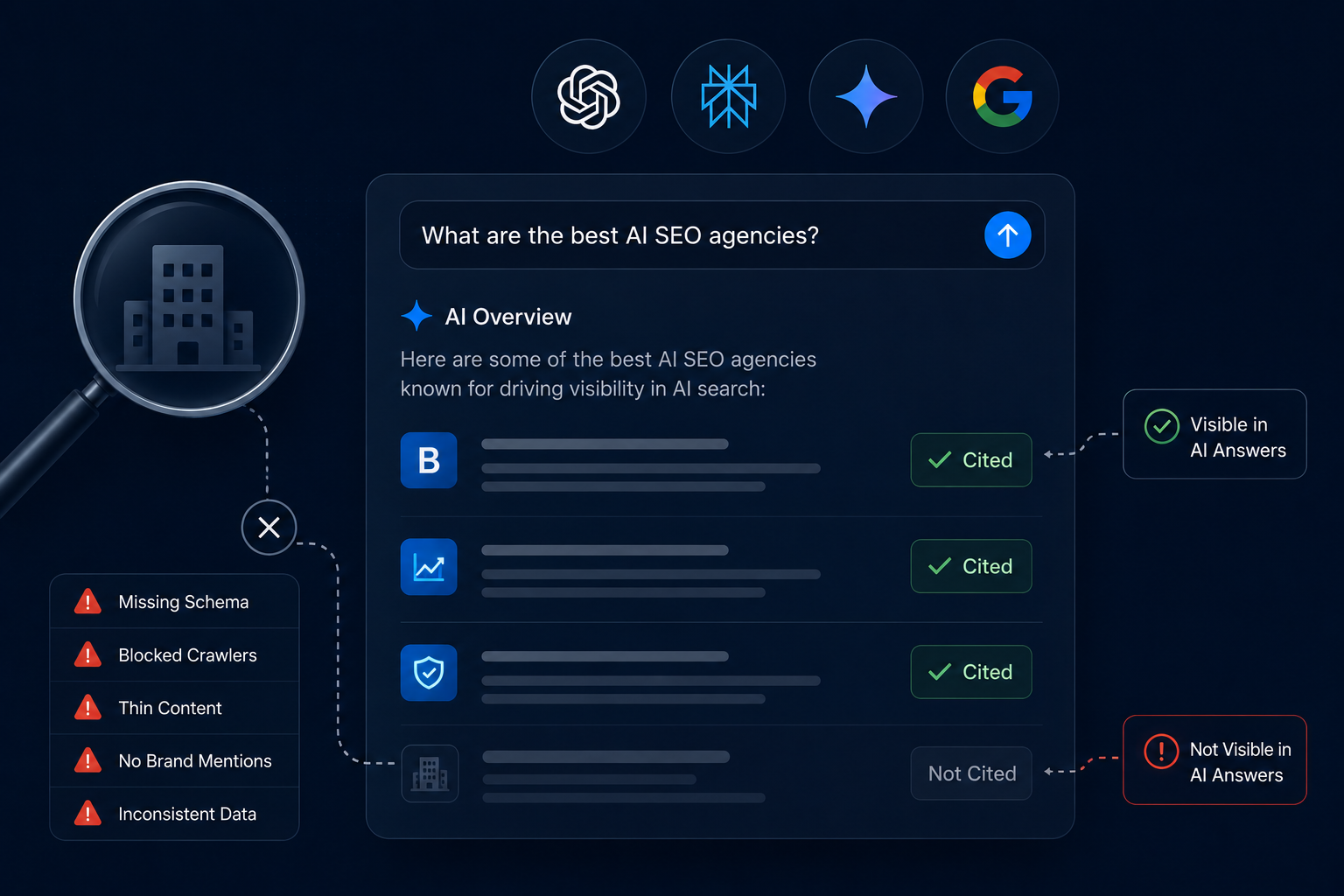
The search landscape is already being rewritten by AI. ChatGPT, Perplexity, and Google’s AI Overviews have become the new gateways to information, and the brands showing up there are optimizing strategically in order to do so.
If your brand isn’t appearing in these AI-generated answers, the problem isn’t that you’ve fallen behind on traditional SEO (or that SEO itself is dead); it’s that you’re optimizing for an algorithm that’s moved on, so to speak.
Generative Engine Optimization (GEO), or AI SEO, is about positioning your brand as a trusted source within the content that AI creates. And while the shift sounds daunting, most visibility issues stem from easily corrected missteps.
Before rewriting your entire digital strategy, start by avoiding the 10 GEO mistakes that kill AI visibility.
How AI Visibility Is Different From SEO Rankings
In traditional search, visibility means getting clicked. A high Google ranking puts you in front of someone who still has to choose to visit your site. That’s a click-based model where impressions drive traffic, and traffic drives conversions.
AI search works a bit differently. Think of it like the difference between appearing in a phonebook versus being the person a trusted friend recommends by name. When someone asks ChatGPT which accounting software to use for a small business, or asks Perplexity to summarize the best options in your industry, the AI synthesizes an answer from sources it trusts, and as a result, the user may never visit any website at all.
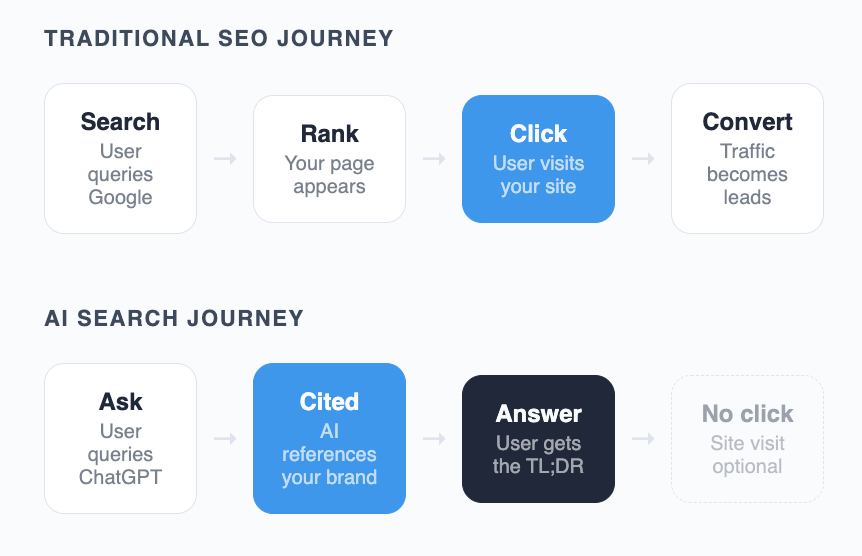
Brand visibility in AI search means being named, cited, or summarized in that generated answer. It’s citation-based discovery.
This is why brands with solid SEO are still being excluded from AI-generated answers. Strong Google rankings can improve the odds of AI visibility, but they do not guarantee it, because AI citation systems often use different signals than traditional search ranking systems.
10 Common Mistakes That Hurt Brand Visibility on AI
Some of these mistakes are technical, some are content-related, and some are strategic. All of them are fixable.
Mistake #1: Treating AI SEO the Exact Same as Traditional SEO
AI engines extract meaning, synthesize answers, and cite sources they’ve determined to be credible. A strategy built solely around keyword density and on-page optimization doesn’t reflect how LLM optimization truly works.
The system is citation-based, not position-based, and brands applying old thinking to a new architecture will consistently underperform.
How to fix it:
- Shift the primary goal from ranking for keywords to being cited as an authoritative source on specific topics.
- Focus on entity clarity. In other words, make sure AI systems can unambiguously understand who you are, what you offer, and why you’re credible.
- Build topical authority through depth and consistency, not keyword frequency.
- Think of LLM optimization as reputation management for machines. The signals that matter are trust signals, not traffic signals.
Mistake #2: Ignoring Content Structure and Extractability
AI platforms don’t read your content the way a human does. They pull clean, structured answers. Dense, unbroken prose with no clear hierarchy is regularly skipped in favor of content that’s easier to process and extract.
If a model has to work hard to find your answer, it won’t when someone else’s better-formatted content is right there.
How to fix it:
- Lead every section with a direct answer, then provide supporting context.
- Use descriptive H2 and H3 headings that mirror how users actually phrase questions
- Break long explanations into shorter paragraphs; three to four sentences per paragraph is a strong default
- If a section answers a specific question, structure it like a direct response, not an essay
Mistake #3: Missing or Incomplete Schema Markup
Schema markup is to LLM optimization what backlinks were to early SEO: a structured signal that tells AI systems exactly who you are, what you do, and why your content is credible.
Without schema markup, your content is semantically ambiguous. AI models are making probabilistic inferences about your brand based on incomplete information, which consistently disadvantages you against competitors who’ve made that information explicit.
For most sites, implementation is more accessible than it sounds. Plugins like Rank Math and Yoast handle the heavy lifting. The 2025 Web Almanac confirms that structured data is increasingly being used by large language models to understand what a page represents, not just what it says, and Microsoft has confirmed that Bing uses schema.org markup to help its models distinguish between expert articles, products, reviews, and FAQs. Most teams just haven’t made it a priority yet.
How to fix it:
- Implement FAQ, HowTo, Organization, and Article schema on your highest-value pages
- Use tools like Google’s Rich Results Test, Rank Math, or Yoast to validate implementation
- For local businesses, make sure your LocalBusiness schema is accurate and consistent with your other web properties
Mistake #4: Accidentally Blocking AI Crawlers
Your content can rank perfectly well on Google and still be completely invisible to AI search systems. robots.txt configurations, Cloudflare rules, and JavaScript-heavy rendering can prevent AI bots from indexing your content without you ever knowing.
How to fix it:
- Audit your robots.txt file specifically for AI crawlers, including GPTBot, PerplexityBot, ClaudeBot, and GoogleOther
- Make sure your most important content is server-side rendered and accessible without a login, paywall, or JavaScript dependency
- Review CDN and firewall settings that may be blocking non-Googlebot user agents
Mistake #5: Publishing Thin or Generic Content
Ask yourself whether your piece says something a model couldn’t reconstruct from a hundred other sources? If not, it might not get cited.
AI engines are trained to cite authoritative, substantive sources. Generic content, or the kind that restates what everyone already knows, generates low reasoning value.
An AI model can recall your words, but it won’t cite your logic, name your brand, or surface your perspective in a synthesized answer. You’re invisible because you’re forgettable.
How to fix it:
- Invest in original research, proprietary data, and expert perspectives that can’t be easily paraphrased away
- Take clear, defensible positions on the topics relevant to your industry. Content that hedges everything contributes nothing
- Attribute content to named authors with visible credentials because authorship signals matter for brand visibility in AI search
Mistake #6: Inconsistent Brand and Entity Information Across the Web
AI models cross-reference facts about your brand across your domain, third-party sites, directories, and structured data sources. When they find contradictions, say, a different founding year here, an inconsistent service description there, or a mismatched address somewhere else, your entity’s credibility takes a hit. Inconsistency is interpreted as unreliability, and unreliable entities don’t get cited.
How to fix it:
- Audit your brand entity information across your website, Google Business Profile, Crunchbase, LinkedIn, and any major industry directories
- Make sure your About page, press mentions, and NAP (name, address, phone) data are consistent everywhere
- If your business has evolved, update all legacy descriptions proactively rather than letting outdated versions persist. Treat brand entity consistency as an ongoing maintenance task.
Mistake #7: Having No Off-Site Brand Presence
A brand that only exists on its own website is nearly invisible to AI systems. AI engines use third-party mentions, press citations, unlinked brand references, and directory listings as authority signals. These are the signals that tell an AI model your brand is real, relevant, and worth citing.
Common mistakes that hurt brand visibility on AI often come down to this: the brand hasn’t earned the external validation that AI systems use to establish trust.
How to fix it:
- Prioritize digital PR campaigns that generate press coverage in credible publications
- Pursue guest articles, podcast appearances, and inclusion in industry roundups and comparison listicles
- Encourage customer reviews and case studies on third-party platforms
- Think of every external brand mention as a citation signal, regardless of whether it includes a link. Unlinked mentions still improve brand visibility in AI search
Mistake #8: No FAQ or Q&A Content on Key Pages
When someone asks an AI tool a direct question, it looks for a direct answer. Long-form prose that buries the response three paragraphs in loses to a well-structured Q&A almost every time, while structured, extractable FAQ content is exactly what AI systems tend to surface.
How to fix it:
- Add dedicated FAQ sections to your service pages, landing pages, and cornerstone blog posts
- Write each answer in two to four sentences, structured to be directly extractable
- Apply FAQPage schema on publication so AI systems can identify and process the Q&A structure
- Prioritize questions that match how your customers speak
Mistake #9: Never Refreshing or Updating Existing Content
Content that hasn’t been updated in 12 months or more signals potential unreliability. The information may be outdated, the context may have shifted, and the source may no longer be active. Letting your best content go stale is one of the most common GEO mistakes to avoid, and one of the most underestimated.
How to fix it:
- Build a content refresh cadence with a minimum of quarterly reviews for your highest-priority pages
- Update statistics, examples, and references to reflect current conditions
- Add new context where the landscape has shifted
- Republish with a clearly updated date so both AI crawlers and users can see the content is current
Mistake #10: Not Measuring AI Visibility at All
Most teams are still measuring performance by Google rankings and organic traffic alone. Neither metric tells you how your brand is appearing in AI-generated answers.
If you’re not tracking AI search visibility, you’re optimizing blind, and the gap between your perceived performance and your actual brand presence in AI systems will only grow.
How to fix it:
- Manually test brand and category queries in ChatGPT, Perplexity, and Gemini at least monthly and document what you find
- Use dedicated tools like Semrush’s AI Visibility Toolkit or Profound to establish a baseline and track changes over time
- Monitor referral traffic from AI platforms in GA4 to see exactly how much traffic (and by extension, leads) is arriving from these channels
- Set a benchmark now, even an imperfect one, so you can measure improvement as your GEO strategy matures
Your AI Visibility Audit Checklist
Run through this checklist as a starting-point audit. Any unchecked item represents a fixable gap in your current strategy.
- Content leads with direct answers and uses clear H2/H3 headings that mirror user questions
- Schema markup implemented on key pages (FAQ, HowTo, Organization, Article)
- AI crawlers are not blocked in robots.txt, CDN configuration, or firewall rules
- Key content is server-side rendered and publicly accessible without login or paywall barriers
- Brand entity information is factually consistent across all web properties, directories, and third-party sources
- Off-site brand mentions and digital PR placements are actively being built
- FAQ sections are present on service pages, landing pages, and cornerstone blog posts
- Core content has been reviewed and refreshed within the last 90 days
- AI visibility is being tracked via manual prompt testing and/or dedicated tools
FAQs About AI Search Visibility
What are the most common GEO mistakes to avoid?
The most consistent patterns are missing or incomplete schema markup, inconsistent brand entity data across the web, no meaningful off-site presence, and content that isn’t structured for AI extraction.
Is optimizing for AI search the same as traditional SEO?
Somewhat. For example, there’s significant overlap in citation or “ranking” factors, like quality content, E-E-A-T signals, and domain authority. The larger differences are in how visibility is earned. For one, AI search is citation-based rather than click-based, rewards entity clarity and extractable formatting, and weighs off-site brand mentions as heavily as on-site content. Strong SEO is a foundation for AI visibility, but it’s not a guarantee of it.
How long does it take to improve AI search visibility?
Meaningful visibility gains typically emerge over a two- to six-month window. Quick wins (schema markup, content restructuring, robots.txt corrections) can elicit faster results because they resolve blockers directly. Authority-building signals like digital PR and off-site mentions compound over time, contributing to sustained improvement rather than one-time lifts.
Do I need a big budget to start fixing GEO mistakes?
No. The foundational fixes, like implementing schema via Yoast or Rank Math, restructuring existing content for extractability, and auditing NAP consistency, are achievable without significant spend. Where professional support adds the most leverage is in authority-building (digital PR at scale) and technical audits for larger sites with complex architectures. But the starting point is accessible to any team willing to be methodical.
Start Fixing These GEO Mistakes Before Your Competitors Do
Right now, AI tools are generating answers to questions your customers are asking, and those answers are naming some brands and not others. The businesses that begin correcting these GEO mistakes today are building a compounding advantage over those who wait.
The good news is that you don’t need to overhaul your strategy to get started. Schema markup, content restructuring, and brand consistency are achievable starting points that deliver real results. If you’re ready to move faster, our AI SEO services can help you close the gap with a structured approach tailored to where your brand stands today.