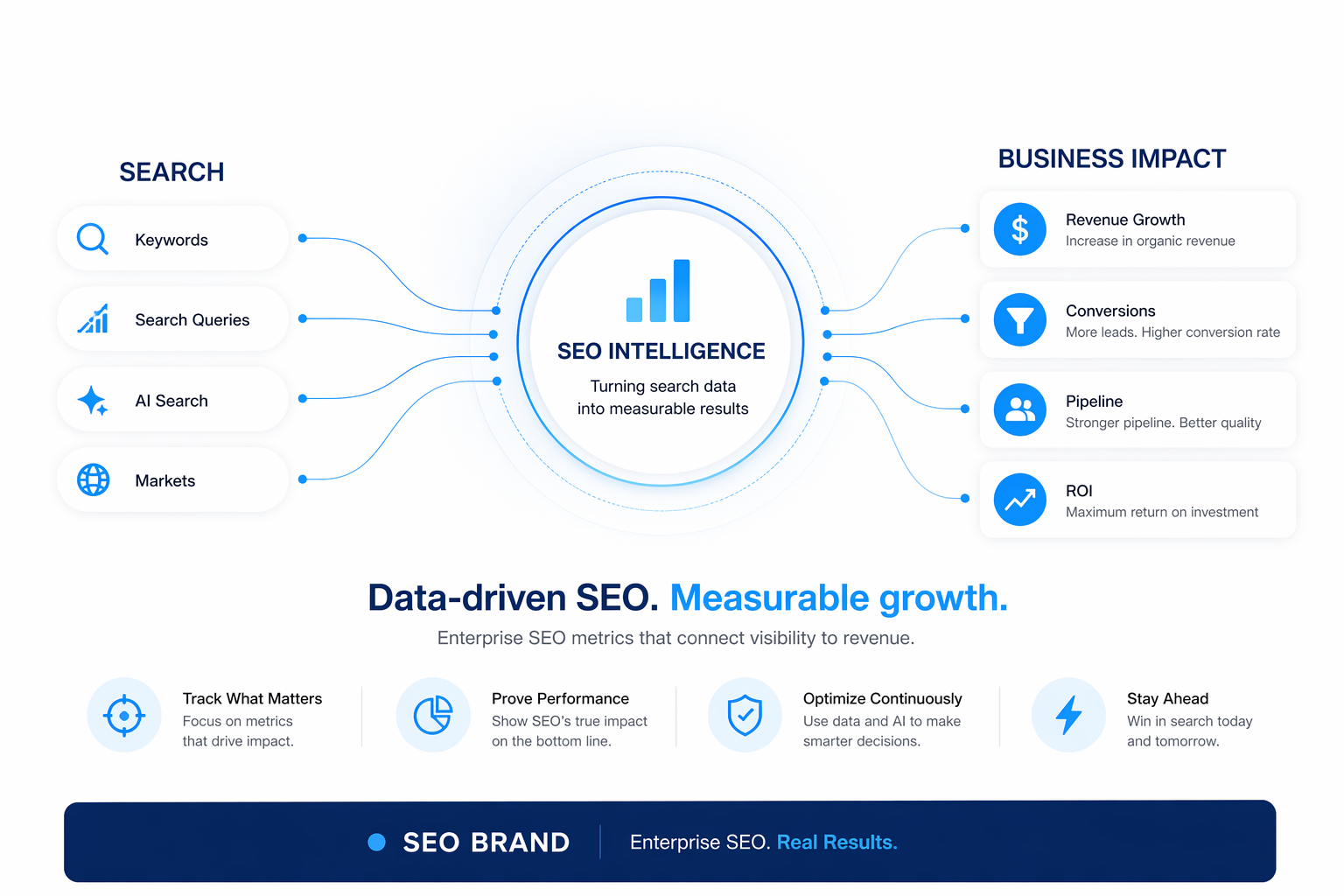
Enterprise SEO metrics are the data points that measure how effectively large-scale SEO efforts drive visibility, traffic, and revenue. The right enterprise SEO metrics, combined with performance measures, allow organizations to track search performance and directly tie optimization efforts to measurable ROI.
Why Enterprise SEO Performance Metrics Matter More Than Ever
Enterprise SEO performance is fundamentally different from traditional SEO. At scale, you are not tracking dozens of pages; you are managing thousands or even millions across multiple domains, subdomains, and global markets.
For Fortune 500 companies and enterprise organizations, measurement complexity increases due to:
- Multi-domain tracking across brands, regions, and product lines
- Multiple stakeholders, including marketing, product, IT, and executives
- Long sales cycles with multi-touch attribution
With over 20 years of experience supporting enterprise clients, SEO Brand has seen how disconnected data leads to poor decisions. That is why modern enterprise SEO requires centralized systems powered by advanced solutions such as Skywide AI.
Without the right measurement framework, enterprises face:
- Misaligned reporting between teams
- Over-reliance on vanity metrics like traffic without revenue
- Missed opportunities in high-value search segments
Enterprise SEO is no longer about rankings alone. It is about measurable business impact.
Essential Metrics for Enterprise SEO Success
To properly evaluate enterprise SEO, you need a multi-layered framework. Focusing only on traffic is a major mistake.
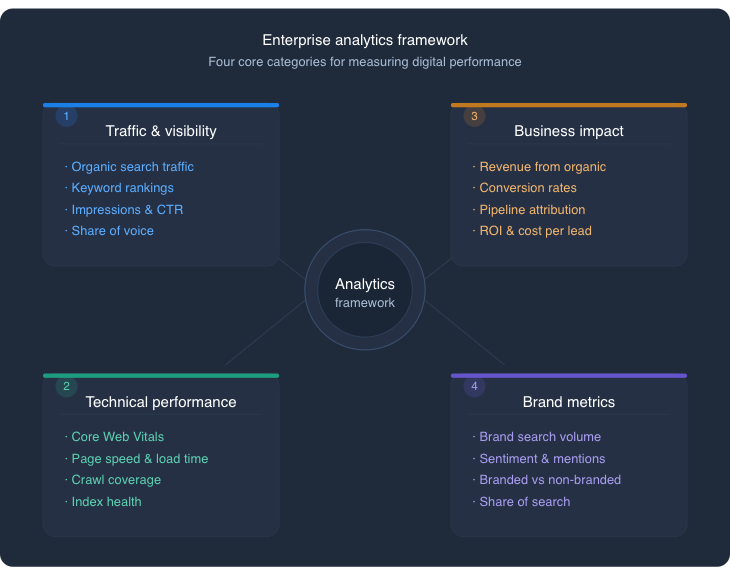
Each category plays a critical role in enterprise success.
For example:
- Traffic without conversions equals wasted opportunity
- Technical health without visibility limits growth
- Brand visibility without attribution creates unclear ROI
Strong metrics for enterprise seo connect all four areas into a unified performance view. This is how organizations move from reporting activity to driving outcomes.
Traffic & Visibility Metrics for Enterprise Scale
At the enterprise level, traffic and visibility must be segmented and analyzed in context.
Key metrics include:
- Organic traffic by page, category, and business unit
- Keyword rankings across thousands of search terms
- Impressions and CTR from Google Search Console
- Search performance for enterprise seo across regions
Unlike smaller websites, enterprise organizations must evaluate performance across:
- Multiple domains and subdomains
- International markets
- Product lines and service categories
Proper configuration of Google Search Console is critical:
- Segment data by country and device
- Separate branded versus non-branded queries
- Analyze performance by page templates
Even a small ranking improvement at enterprise scale can have a significant impact on revenue. A one-position gain across thousands of keywords can translate into millions in additional pipeline.
Technical SEO Metrics That Impact Enterprise Performance
Technical SEO is one of the highest-leverage areas in enterprise environments. Small issues scale quickly.
Core technical metrics include:
- Core Web Vitals, including LCP, CLS, and INP
- Crawl budget efficiency
- Indexation rates across large page sets
- Site speed optimization across templates
Crawl budget becomes critical at scale. Search engines allocate limited resources, so inefficient crawling can prevent important pages from being indexed.
Enterprise teams should also monitor:
- Log file data to understand crawler behavior
- Server response codes at scale
- Rendering issues on JavaScript-heavy pages
A single issue, such as slow load times, can impact thousands of URLs simultaneously. This makes technical SEO essential for maintaining enterprise performance.
Business Impact & Revenue Attribution Metrics
This is where most SEO programs fail. They cannot connect performance to revenue.
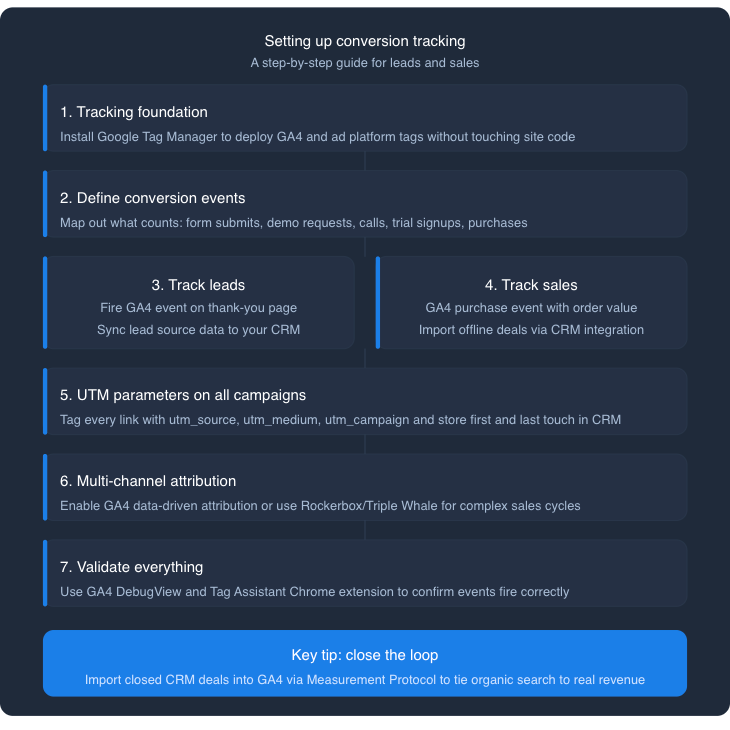
The key question becomes:
How does SEO impact revenue and pipeline?
When done correctly, SEO becomes a measurable growth channel, not just a visibility channel.
Advanced Analytics Setup for Enterprise SEO
Enterprise SEO requires a scalable analytics infrastructure built on Google Analytics 4, cross-domain tracking, custom event tracking, and BigQuery integration. GA4 alone is not sufficient at this level. BigQuery enables large-scale data storage, advanced attribution modeling, and predictive insights.
Reporting must also be segmented by audience. Executives need ROI and revenue visibility, marketing teams need traffic and conversion data, and technical teams need site health insights. Without this segmentation, data becomes difficult to act on and loses strategic value.
Brand Visibility & Share of Voice Measurement
Enterprise SEO is also about market positioning.
Key metrics include:
- Brand visibility across search results
- Share of voice versus competitors
- Featured snippet ownership
- AI search visibility in tools like ChatGPT and Perplexity
Modern SEO requires optimization for AI-driven search environments.
This includes:
- Entity optimization
- Structured content for AI retrieval
- Brand mentions across authoritative sources
Companies that dominate visibility in both traditional and AI search will capture a disproportionate share of the market.
Executive Reporting: Translating SEO Data into Business Intelligence
Enterprise seo performance measures must be translated into clear business value to drive executive alignment. Leadership teams prioritize revenue growth, lead generation, market share, and cost efficiency, not technical SEO outputs.
Effective executive reporting connects SEO performance directly to these outcomes through C-suite dashboards, structured quarterly business reviews, and forward-looking forecasting tied to budget justification. At SEO Brand, a 95 percent client retention rate reflects the ability to consistently demonstrate measurable impact. When done correctly, executive reporting positions SEO as a revenue driver rather than a cost center.
Multi-Domain and International SEO Metrics
Enterprise organizations typically operate across multiple domains, subdomains, and international markets, which adds complexity to measurement. Performance must be tracked across brands, business units, and regions, with reporting tailored to each market.
Regional performance often varies due to language differences, cultural nuances, and shifts in search behavior. Without proper segmentation, these variations are missed, leading to inaccurate conclusions. Accurate multi-domain tracking requires structured reporting by market, enabling teams to identify opportunities, uncover inefficiencies, and scale what works across regions.
AI and Future-Proofing Enterprise SEO Measurement
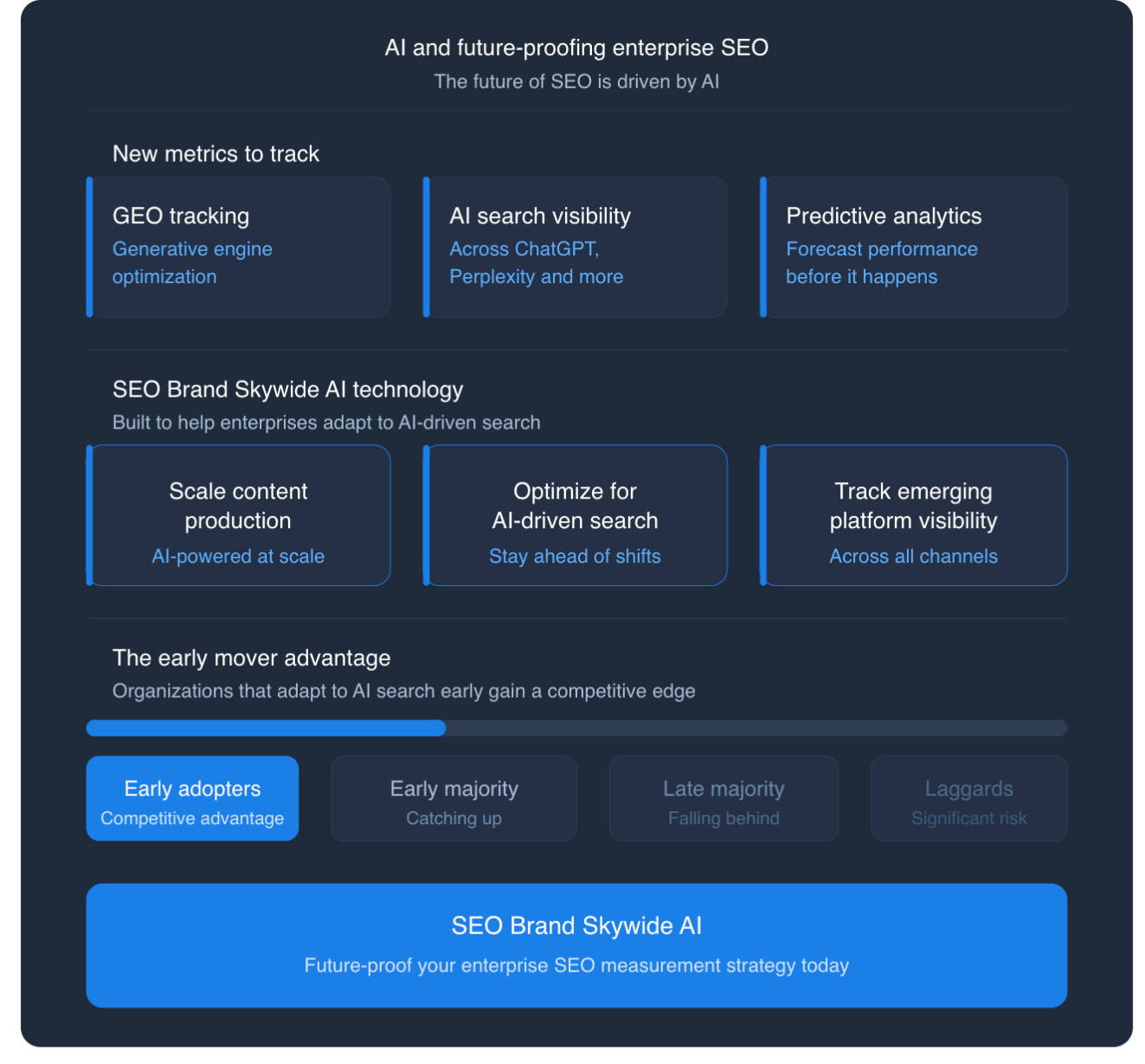
Enterprise SEO Performance Measures and KPI Selection
Not all metrics are useful. Many organizations focus on the wrong data.
Common measurement mistakes include:
- Tracking vanity metrics instead of revenue
- Ignoring data accuracy issues
- Misalignment between stakeholders
Effective enterprise seo performance measures should be:
- Actionable
- Aligned with business goals
- Consistent across teams
Strong metrics for enterprise seo focus on decision-making, not just reporting.
Getting Started: Enterprise SEO Metrics Implementation Roadmap
Implementing enterprise SEO measurement requires a structured approach.
Step-by-step roadmap:
- Define business goals and KPIs
- Select tools and analytics platforms
- Establish baseline metrics
- Configure tracking and dashboards
- Align teams and reporting structures
Most enterprises benefit from expert guidance during implementation.
A structured measurement program ensures long-term success and scalability.
Frequently Asked Questions
1. What enterprise SEO metrics should executives focus on?
Executives should focus on revenue, ROI, lead generation, and market share. These metrics directly reflect business impact, unlike technical SEO metrics, which are more operational.
2. How often should enterprise SEO metrics be reported?
Weekly reports should focus on tactical performance, while monthly reports summarize progress. Quarterly reviews should align SEO results with business objectives and strategy.
3. What is the difference between enterprise and standard SEO tracking?
Enterprise SEO involves scale, multi-domain tracking, multiple stakeholders, and complex attribution models. Standard SEO typically focuses on smaller sites with simpler reporting needs.
4. How do you track ROI from enterprise SEO efforts?
ROI is tracked using attribution models, conversion tracking, and customer lifetime value. SEO impact is measured across the full customer journey, including assisted conversions.
5. Which tools are best for enterprise SEO metrics tracking?
Enterprise platforms like BrightEdge and Conductor are ideal for scaling, while integrated stacks that use GA4, Search Console, and visualization tools provide flexibility.
Final Thoughts
Enterprise SEO metrics are the foundation of scalable growth. When implemented correctly, enterprise seo metrics provide clear visibility into performance, align teams, and drive measurable revenue outcomes across the organization.